The building sector in Ireland, like across Europe, faces a fast-approaching regulatory shift. From 2028, all new public buildings must be zero emission, and from 2030, the same applies to every new building. Developers and investors are already under pressure to ensure their portfolios will comply.
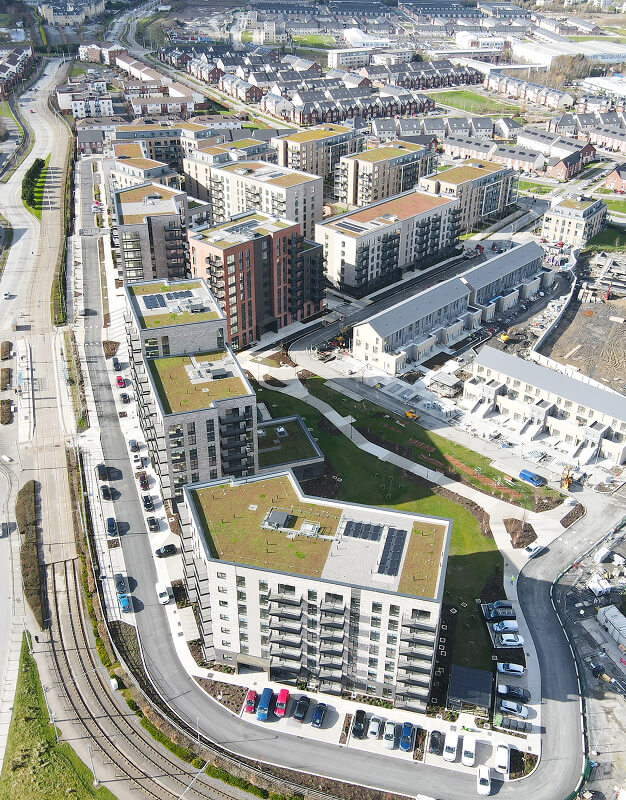
Pipers Square in Charlestown, Dublin, with 598 apartments designed to the Passivhaus standard, demonstrates how future-proofed housing can be delivered at scale today. For Cairn Homes, the developer, and for Mosart as the Passivhaus consultants, the project is not just about meeting certification requirements. It is about anticipating regulation and aligning with the wider ESG agenda.
Anticipating Regulation Before It Arrives
The European Energy Performance of Buildings Directive (EPBD) sets clear targets. New developments will need to be zero emission within the decade, and compliance will require evidence, not just design intent.
By committing to Passive House performance, Pipers Square delivers:
- Measured airtightness and energy demand modelling that provide verifiable outcomes
- Heating demand far below NZEB levels, proving that standards already surpass current regulation
- Certification pathways that give developers assurance against future compliance risks
In other words, what is coming in 2030 is already being delivered in Charlestown today.
Why Passivhaus is a Compliance Strategy
Building to the Passivhaus standard is not only about efficiency. It is a compliance strategy in itself.
- Predictability: Modelling through PHPP and performance testing provides reliable evidence for planning submissions and regulatory checks
- Resilience: Homes designed to such a high standard remain compliant even as regulations tighten, avoiding costly retrofits
- Data for ESG reporting: Measured performance offers hard evidence for environmental disclosures, strengthening governance and investor confidence
For developers, this reduces the risk of stranded assets and ensures projects remain marketable for decades.
Mosart’s Role in Regulatory Alignment
As Passivhaus consultants, Mosart worked with Cairn to ensure that regulatory readiness was embedded into Pipers Square from the outset. This included:
- Thermal bridge modelling to reduce energy demand and prevent hidden risks
- Airtightness strategies that simplified delivery while achieving the strict Passivhaus thresholds
- Advising on component selection and construction detailing to align with certification requirements
The result is a scheme that not only achieves Passivhaus performance but also positions itself securely against the legislative changes that are on the horizon.
The ESG Perspective
For ESG leaders, Pipers Square offers three key benefits:
- Environmental: Verified reductions in operational carbon align with Scope 1 and 2 targets
- Social: Lower running costs and healthier homes strengthen the social value of the development
- Governance: Certification provides a trusted framework for reporting, reducing reputational risk
This combination of measurable outcomes strengthens both investor confidence and regulatory compliance.
Conclusion
Pipers Square is more than Ireland’s largest Passive House apartment scheme. It is a signal that zero-emission housing is no longer a future ambition but a present reality. For developers, it demonstrates that compliance with 2028 and 2030 regulations can be achieved now.
Mosart’s consultancy ensured that every detail of the project aligned with both certification and future-proofed regulation, giving Cairn Homes and its stakeholders confidence that Pipers Square will stand the test of policy, performance, and time.
For ESG directors and developers alike, Pipers Square offers reassurance that building better today is the simplest route to being ready for tomorrow.