
You’ve probably heard both terms thrown around on job sites and in planning meetings: “We’re building to Passive House standards” or “This is a net-zero energy building.”
But not everybody understands the key differences and that confusion costs projects time, money, and clarity.
In 2026, with Ireland’s Zero Emission Building (ZEB) regulations now live and the global shift towards low-carbon construction accelerating, understanding the actual difference between Passive House and NZEB isn’t optional knowledge, it’s essential. Your choice between them shapes your design process, your budget, your timescale, and ultimately, how your building performs.
What Is Passive House?
Passive House (or Passivhaus, the German standard) is a rigorous building methodology that focuses on one core principle: dramatically reduce the energy your building needs in the first place.
It’s about geometry, insulation, airtightness, and thermal design working together so that your heating and cooling demands are minimal. A Passive House typically needs 90% less heating energy than a conventional building.
Here’s how it works in practice. A Passive House uses:
- Super-insulation (walls, roof, foundation)
- High-performance triple-glazed windows with thermal breaks
- Airtight construction (tested and verified)
- Mechanical ventilation with heat recovery (MVHR)
- Strategic solar orientation and shading
- Elimination of thermal bridges
The result? A building that stays warm in winter and cool in summer with almost no conventional heating or cooling systems needed. Most Passive House projects can achieve comfort using just a small electric heater or heat pump, often paired with recovered ventilation heat.
Passive House is a design discipline. It’s prescriptive. It sets specific U-values, air-tightness targets (0.6 air changes per hour at 50 Pa), and uses sophisticated modelling (PHPP software) to verify performance before construction even starts.
This is why builders and architects respect it. You can’t cheat a Passive House standard. It’s independently verified.
The credential matters: Passive House certification comes from the Passive House Institute (Germany) or similar bodies like PHI (Passive House Institute) Austria. Thousands of projects globally carry the badge, from residential towers in Vienna to schools in Ireland and commercial buildings across the UK.
What Is NZEB?
Nearly Zero Energy Building (NZEB) is the current European standard. It’s been the legal requirement for all new buildings across Ireland and the UK since 2019.
NZEB is a different animal than Passive House. Rather than starting with “how do we minimise energy demand,” NZEB starts with the full energy balance of the building.
An NZEB is defined as a building where the energy it produces (usually from renewable sources, typically solar PV) equals or exceeds the energy it consumes over a year. The focus is on achieving net-zero energy consumption, not on how you get there.
Here’s the critical distinction. An NZEB can be thermally weak but compensate with bigger renewable systems. A building with modest insulation, average windows, and moderate air-tightness can still achieve NZEB status if it instals enough solar panels to offset its annual consumption.
NZEB focuses on balance and flexibility. It’s a regulatory floor, not a design philosophy.
In Ireland, current NZEB requirements are:
- Residential buildings: B2 BER rating minimum, with at least 20% of energy from on-site or nearby renewables
- Non-residential buildings: A3 BER rating minimum, with at least 20% of energy from on-site or nearby renewables
This standard has been in place since 2019 and continues to apply to all new buildings until it’s superseded by Zero-Emission Building (ZEB) requirements in 2028 and 2030.
The Visual Difference
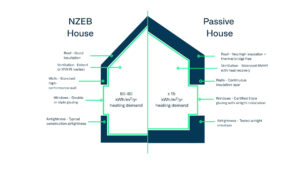
Imagine two buildings side by side:
Building A (Passive House approach)
- Super-insulated envelope
- Triple glazing
- Airtight construction with MVHR
- Small heat pump or electric heater
- Minimal renewable systems needed
- Exceptional interior comfort (stable temperatures, no draughts, excellent air quality)
- Consistent, predictable performance year-round
- Resilient (performs well regardless of weather)
Building B (NZEB approach)
- Standard insulation (to code)
- Double glazing
- Conventional ventilation and HVAC
- Standard heating system
- Large solar PV array (essential for balance)
- Interior comfort depends on HVAC operation
- Performance depends on weather (sunny years vs cloudy years)
- More dependent on renewable output
Both can satisfy current regulations. Only Building A is Passive House.
Key Differences at a Glance
| Aspect | Passive House | NZEB |
|---|---|---|
| Primary Strategy | Minimise energy demand first | Balance production vs consumption |
| Design Approach | Rigorous envelope optimisation | Flexible; emphasis on renewables |
| Heating/Cooling Need | Minimal (< 15 kWh/m²/year) | Standard to moderate |
| Verification | PHPP modelling; on-site blower door and thermography | SAP/energy modelling; operational monitoring |
| Interior Comfort | Exceptional (stable temps, superior air quality) | Variable (depends on system control) |
| Operating Costs | Minimal and predictable | Low (if renewables perform well) |
| Design Complexity | High (rigorous modelling required) | Moderate (flexible approaches) |
| Renewable Energy | Optional; rarely needed | Usually required to achieve zero balance |
| Weather Dependent | No | Yes (PV output varies) |
| Current Regulation Status | Voluntary (premium positioning) | Mandatory (all new buildings, until 2028/2030) |
The Regulatory Shift: NZEB to ZEB in 2026-2030
This is where the landscape is changing, and it’s important to understand what’s coming.
Current state (until 2028/2030):
NZEB is still the legal requirement. All new buildings must meet NZEB standards. In Ireland, this means residential buildings achieve a B2 BER and non-residential buildings achieve an A3 BER, with at least 20% of energy from renewables.
The new mandate (from 2028 onwards):
The recast Energy Performance of Buildings Directive (Directive 2024/1275), which came into force on 28 May 2024, introduces a stricter standard called Zero-Emission Building (ZEB). This is higher than NZEB and is now Europe’s new target.
Zero-Emission Buildings are defined as buildings with:
- Very low energy demand
- No on-site carbon emissions from fossil fuels
- Either zero or very low operational greenhouse gas emissions
The timeline is phased:
From 1 January 2028, all new public buildings in Ireland must meet ZEB standards.
From 1 January 2030, all new residential and non-residential buildings in Ireland must meet ZEB standards.
This represents a significant step-change in ambition. NZEB allows fossil fuel heating paired with renewables. ZEB requires the elimination of fossil fuel systems entirely.
What this means: Between now and 2030, if you’re designing a new building, you need to understand both NZEB (current legal requirement) and ZEB (the incoming requirement). For buildings with planning permission before 2028/2030, NZEB may still apply. For projects after those dates, ZEB is mandatory.
A secondary consideration: operational energy dominates a building’s carbon footprint over its lifespan. A Passive House’s minimal heating demands mean it starts with a carbon advantage, though material choices and renewables integration matter equally in the full picture.
Why This Matters in 2026
Three reasons this distinction is no longer academic:
1. Regulatory trajectories are diverging
You’re no longer choosing between two stable standards. You’re navigating a shift from NZEB to ZEB.
If your project has planning permission before 2028 (public buildings) or 2030 (residential and non-residential), NZEB compliance may be sufficient. But many developers are already designing to ZEB standards in anticipation of the 2030 deadline. Why? Because retrofitting a building designed to NZEB standards to meet ZEB requirements post-2030 will be expensive.
A Passive House naturally exceeds ZEB requirements. A building designed to Passive House standards will meet future-proofing requirements automatically. An NZEB building relying on fossil fuel heating and solar offset may require substantial retrofit when ZEB regulations take effect.
The risk? If your solar array underperforms due to weather or shading, or if electricity prices spike, your building’s “net zero” status becomes fragile. A Passive House, by contrast, remains comfortable and low-energy regardless of external conditions or grid pressures.
2. Whole-life value shifts over 30+ years
The upfront cost of Passive House construction is typically 5-10% higher than conventional building. But operational savings compound dramatically.
Over 30 years, a Passive House with minimal heating demands and superior air quality often delivers better total value than an NZEB reliant on high renewable generation and mechanical cooling. The difference becomes even more pronounced if energy costs rise or renewable technology becomes less cost-effective.
There’s a third factor that rarely gets mentioned: occupant experience. Passive House occupants report higher satisfaction, fewer complaints about temperature or air quality, and measurable health benefits (fewer respiratory issues, better sleep, higher productivity). This translates to lower turnover in commercial buildings and higher rental yields. In residential, it means healthier living environments.
3. Future-proofing against uncertainty
An NZEB dependent on fossil-fuel-free electricity is only secure if your grid remains decarbonised and affordable. A Passive House building is resilient regardless. If electricity costs rise or renewable capacity becomes constrained, your Passive House still delivers comfort at minimal cost.
Similarly, climate change means hotter summers. A building designed for minimal cooling demand (Passive House) ages better than one relying on active air conditioning systems that consume more electricity in hotter years.
What Ireland’s Builders and Architects Are Doing
The market is shifting faster than regulations require.
Cairn and LDA are scaling Passive House residential projects. Educational projects are moving toward Passive House for the long-term value and occupant health. Even developers traditionally sceptical of “premium” standards are discovering that Passive House appeals to end-users and future-proofs assets.
The regulatory mandate for NZEB created awareness. The shift to ZEB is creating urgency.
But knowledge gaps persist. Architects aren’t sure how to detail an airtight junction. Contractors worry about costs and sequencing. Planners lack confidence in sign-off. Building inspectors need training on new standards.
This is where expertise matters. The difference between a Passive House that actually performs and one that doesn’t comes down to design rigour, site management, and skilled tradecraft.
The Bottom Line
Passive House is a design philosophy rooted in physics. NZEB is a regulatory requirement based on energy balance. ZEB is a stricter regulatory target that begins in 2028.
You can be NZEB without being Passive House. You cannot be Passive House without exceeding NZEB. A Passive House building also exceeds ZEB standards.
In 2026, choosing between them isn’t a technical question alone. It’s a strategic decision about the building you want to own, operate, or occupy for the next 30 years, and the resilience and value you’re willing to invest in.
FAQs
Q: What’s the actual difference between Passive House and NZEB?
A: Passive House is a design standard focused on minimising energy demand through superior insulation, airtightness, and ventilation. NZEB (Nearly Zero Energy Building) is a regulatory standard requiring zero net energy consumption, typically achieved through a combination of efficiency measures and renewable generation. A Passive House naturally exceeds NZEB but not all NZEB buildings are Passive House.
Q: Is Passive House mandatory in Ireland?
A: No. Passive House remains voluntary in Ireland and the UK and is considered a premium standard. However, Zero-Emission Building (ZEB) requirements are now mandatory: from 1 January 2028 for public buildings and from 1 January 2030 for all other new buildings. Passive House exceeds ZEB requirements.
Q: What’s the difference between NZEB and ZEB?
A: NZEB (Nearly Zero Energy Building) allows fossil fuel heating paired with renewable energy offset. ZEB (Zero-Emission Building) eliminates on-site fossil fuel emissions entirely and requires very low energy demand. ZEB is stricter and is the regulatory target from 2028/2030 onwards in Ireland and across the EU.
Q: Can a building be both Passive House and NZEB?
A: Yes. A Passive House with integrated solar PV typically exceeds NZEB performance whilst enjoying the superior comfort, resilience, and health benefits of Passive House design. It also naturally meets ZEB requirements from 2028/2030 onwards.
Q: Who verifies Passive House certification?
A: The Passive House Institute (Germany) or certified verifiers they authorise. Projects are modelled using PHPP software and tested on-site with blower door testing and thermography to verify airtightness.
Q: When do ZEB regulations take effect in Ireland?
A: Public buildings must meet ZEB standards from 1 January 2028. All other new buildings (residential and non-residential) must meet ZEB from 1 January 2030. Until those dates, NZEB remains the legal requirement.