
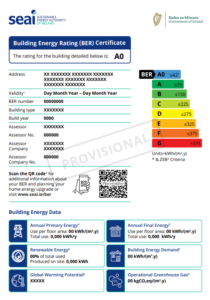
From 24th May 2026, Ireland’s Building Energy Rating system works differently. The 15-point A1-to-G scale is gone, replaced by a simpler eight-band structure running from A0 at the top to G at the bottom. The new A0 band is the headline change: it is reserved for what the directive calls Zero Emission Buildings, with a primary energy threshold below 42 kWh/m²/yr.
Simplifying the scale makes sense. The old system gave an impression of precision that the underlying methodology never really supported. But the detail behind the A0 definition is worth reading carefully before the label becomes a market expectation.
What changed, and why
The old fifteen-band scale ran from A1 through A2, A3, B1, B2, B3, and so on down to G. In practice, the gaps between adjacent bands were often smaller than the margin of uncertainty in the calculation. Eight bands is a more honest reflection of what DEAP’s underlying calculation methodology can reliably distinguish.
The change is required by the revised EU Energy Performance of Buildings Directive, which set a 29th May 2026 deadline for member states to harmonise their energy performance certificates. Ireland has transposed on time. The instrument is S.I. No. 168 of 2026, signed by Minister James Browne on 21st April. Existing BER certificates remain valid for ten years from their date of issue.
The A0 band: what it says, and what it does not
Per SEAI, a Zero Emission Building is a building with a very low amount of energy, producing zero on-site carbon emissions from fossil fuels and zero or a very low amount of operational greenhouse gas emissions, with a primary energy threshold below 42 kWh/m²/yr. Each part of that definition needs unpacking.
Start with the 42 kWh/m²/yr figure. This is not an ambitious Irish policy choice. It is the EPBD’s regulatory floor, set at 10% better than NZEB. For the segment of the Irish market designing to Taxonomy-aligned standards, typically institutionally-financed projects, the A0 threshold is not a step change. It is where that part of the market already is.
The greenhouse gas cap raises a separate question. Ireland has set it at 5 kgCO₂eq/m²/yr under the EPBD’s framework. The directive specifies no number; Member States choose their own. Nothing in the directive prevented Ireland from setting it tighter. Five kilograms of CO₂ equivalent per square metre per year is not zero by any reasonable definition, and a credible zero-emission standard would require at minimum net-annual zero, allowing winter imports offset against summer exports. The chosen figure does not reach that bar.
The renewable energy provision adds a further complication. The directive (Article 11(7)) permits grid-delivered energy to count toward A0 only as a fallback, where on-site generation, renewable energy communities, district heating, or carbon-free sources are not technically or economically feasible. Ireland’s transposing regulations (Regulation 28E of S.I. No. 168 of 2026) permit A0 to be met by grid-delivered energy “whether delivered through the electricity grid or otherwise,” subject to criteria yet to be published. The feasibility test the directive requires has been dropped. Whether the national criteria, when they arrive, will restore it is an open question.
The most fundamental issue sits beneath all of this. The certificate has been transposed, but Part L has not been updated. A0 currently exists as a label without an underlying regulation to enforce it. A building can achieve the rating without any requirement to do so. That is an unusual position for a standard being marketed as the ceiling of building energy performance.
The gap between the rating and the building
Even if the A0 definition were robust, the rating system it sits within has a well-documented performance problem. Coyne and Denny (2021), studying 8,572 Irish dwellings, found that actual whole-home energy use is largely flat across the BER spectrum at around 200 kWh/m²/yr regardless of rated performance. Theoretical energy use varies enormously by band; actual consumption does not follow it. DEAP’s underlying calculation methodology does not reliably predict real-world energy use, and the divergence between calculated and actual performance is largest at the high-performance end of the scale, precisely where A0 sits.
Extending the scale to A0 without addressing that does not solve the problem. It moves the goalposts on a pitch where the measurement system was already unreliable.
Passivhaus certified buildings take a different approach to this. The standard’s requirements for airtightness testing, thermal bridge calculation, and MVHR commissioning substantially narrow the gap between what is modelled and what is built. That narrowing matters more than the label. A0 does not address how to achieve it.
What the new certificate does get right
The updated certificate is meaningfully richer than its predecessor. Alongside the simplified scale, it now shows annual primary energy use, annual final energy use, building energy demand, renewable energy contribution, and operational greenhouse gas emissions. A QR code links directly to home upgrade guidance. For homeowners and tenants trying to understand their building’s energy performance, this is a genuine improvement.
There is also a field for Global Warming Potential. The SI defines it as a whole-life measure covering greenhouse gas emissions embodied in construction products, direct and indirect emissions during use, and end-of-life emissions. On paper, that is the embodied carbon field the industry has been calling for. In practice, it is currently blank. Under the EPBD, whole-life GWP will be required in energy performance certificates for new buildings above 1,000 m² from January 2028, and for all new buildings from January 2030. For most of the market, the obligation to populate the field does not yet apply. The certificate is ahead of the regulation.
Where this leaves the industry
A simpler, more legible scale is a better scale. A richer certificate that captures more of what matters is progress. These are real improvements and worth acknowledging.
But A0, as transposed, sits at the regulatory floor of the directive rather than the ceiling of what Irish practice can deliver. It is built on a GHG cap that Ireland chose and could have set tighter. It allows grid-delivered energy to count as renewable coverage on terms not yet defined. It rests on a calculation methodology whose poor predictive power is documented in the Irish research literature, with the divergence most pronounced at the performance level where A0 now sits. Calling that a Zero Emission Building is a policy decision, not a technical finding.
The buildings that are genuinely approaching zero emission performance are the ones designed to Passivhaus standard, pressure-tested on site, commissioned properly, and monitored in use. That practice does not need to wait for the label to catch up.
Is “Zero Emission Building” an honest label for a building permitted to emit 5 kgCO₂eq/m²/yr and meet its renewable coverage requirement through the grid?