The standard is a threshold, not a target.
Architects who think in building science. Engineers who value design.
Passivhaus Classic, Plus and Premium. ZEB and NZEB. EnerPHit retrofit. As ZEB becomes the direction of regulation, Passivhaus is the most reliable and lowest-cost route to it: reduce the demand first, and the renewable generation needed to reach zero shrinks. The PHPP energy model is live from feasibility in every case, and the standard is held through value engineering and construction, so what gets built performs the way it was designed.
How the three standards differ.
What it isPassivhaus, ZEB and NZEB are three different answers to the question of how a building should perform. They are not interchangeable, and the differences matter to how a building is designed.
Passivhaus is a fabric-first standard: reduce energy demand before adding supply. The PHI Passivhaus Classic threshold is 15 kWh/m²a specific space-heating demand and 0.6 ACH at 50 Pa airtightness. These are absolute thresholds verified by physical testing and PHPP calculation. They cannot be traded off against renewable energy generation.
Passivhaus Plus and Premium add a renewable energy generation requirement on top of the Classic fabric standard. A Plus building generates at least 60 kWh/m²a of renewable energy and has a primary energy renewable demand of no more than 45 kWh/m²a. A Premium building generates at least 120 kWh/m²a with a demand no more than 30 kWh/m²a.
ZEB means annual energy generation equals annual consumption, usually through photovoltaics. NZEB is the EU Directive minimum, defined in national regulations. In Ireland it is set by Part L of the Building Regulations. All of these targets are modelled in PHPP, which we run from the first sketch.
Increasingly the target is ZEB, and this is where Passivhaus earns its place. A ZEB has to balance the energy it uses against the energy it generates, and the cheapest way to reach that balance is to need less energy in the first place. Passivhaus cuts demand so far that the renewable generation required to reach zero, and the plant and roof area that comes with it, shrinks dramatically. Even where full certification is not the goal, designing to Passivhaus principles is the lowest-cost route to ZEB and NZEB compliance.
Space-heating demand: max 15 kWh/m²a. Airtightness: max 0.6 ACH at 50 Pa. Primary energy renewable: max 60 kWh/m²a. These are tested in PHPP and verified by physical pressure test.
The PHI EnerPHit standard applies to retrofit of existing buildings: space-heating demand max 25 kWh/m²a, or component-based compliance where each envelope element meets a minimum performance criterion. We model the retrofit in PHPP and identify the minimum upgrade package for compliance.
How we hold the standard.
MethodThe PHPP model is open at the first design meeting, so the energy consequences of every design decision are visible in real time: changing the window-to-wall ratio, adjusting the roof overhang, specifying a different insulation thickness.
Every figure in the PHPP model must eventually be substantiated by verifiable evidence: the window frame U-value from a manufacturer test report, the insulation thermal conductivity from a product data sheet, the MVHR unit specific fan power and heat-recovery efficiency from a certified test. We manage this specification process and update the PHPP model at each stage so the performance gap between designed and specified is zero before the contractor is on site.
Every substitution proposed during value engineering or procurement is tested in the PHPP model before it is accepted. A cheaper window with a worse U-value increases the space-heating demand. A lower-performing MVHR unit reduces heat recovery. We quantify the effect of every substitution and advise on whether it can be accepted, what compensating change is needed, or why it must be rejected to protect certification.
PHI certification requires that the certifier is independent of the design team. Where Mosart is the architect, a separate Mosart certifier who was not involved in the design acts as the independent certifier. Mosart has 7 PHI-accredited certifiers in-house, the largest independent team in Ireland, so this separation is always available. The certifier reviews the PHPP model, the airtightness test result and the as-built drawings before issuing the certificate.
In practice: Erne Campus.
Evidence The world's first Passivhaus Premium education building.
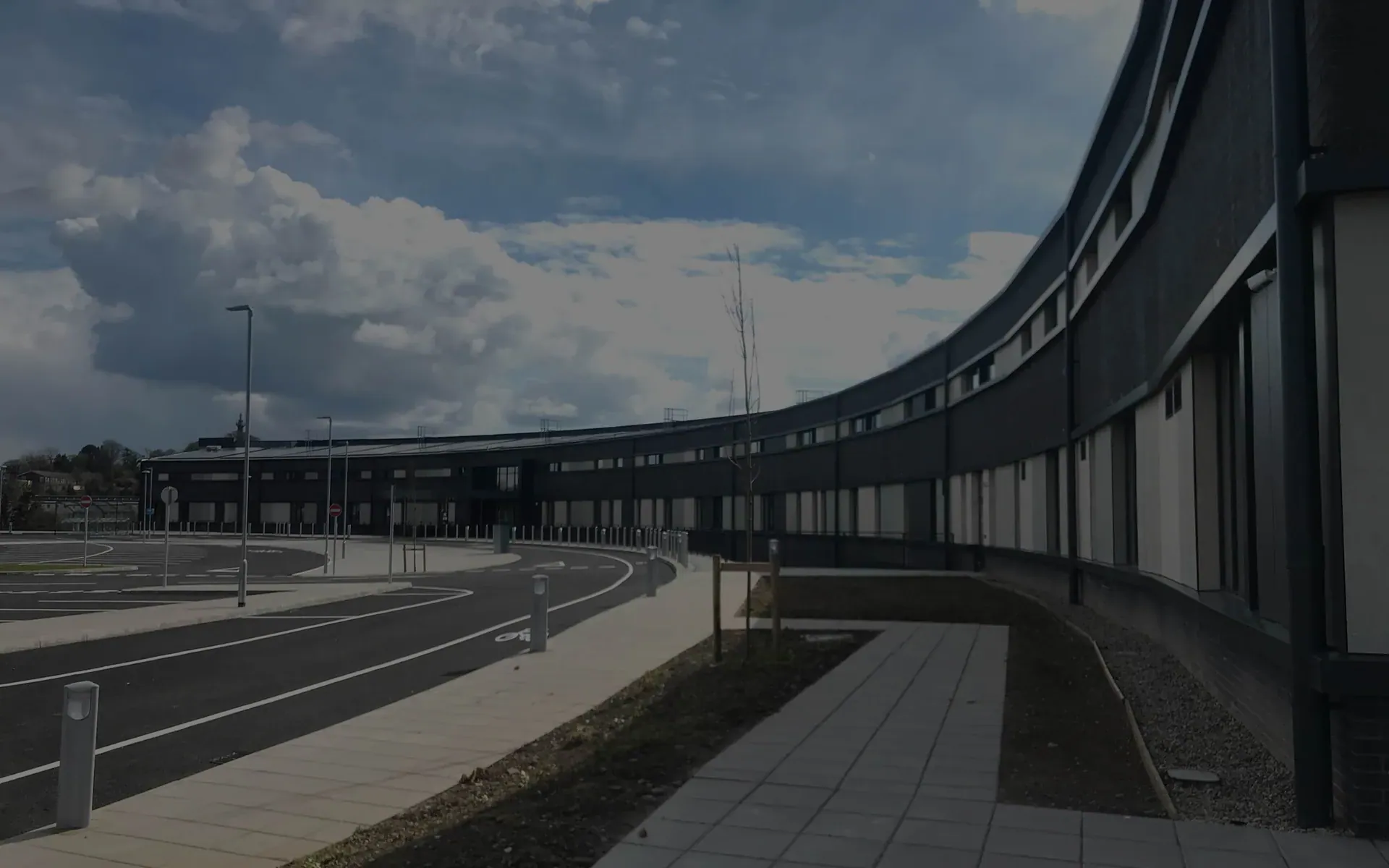
Erne Campus in Enniskillen is the world's first Passivhaus Premium certified education building. The architecture was by others; Mosart was the Passivhaus designer, taking the project from PHPP at feasibility through thermal bridge analysis and value engineering managed against the PHPP model, to PHI certification after the airtightness test.
The building was certified to Passivhaus Premium, the highest PHI classification, combining the Classic fabric performance (space-heating demand below 15 kWh/m²a, airtightness at 0.6 ACH at 50 Pa on a physical pressure test) with on-site renewable generation.
Common questions.
FAQWhat is the difference between Passivhaus, ZEB and NZEB?
Passivhaus is a fabric-first performance standard with absolute thresholds: 15 kWh/m²a specific space-heating demand and 0.6 ACH at 50 Pa airtightness, verified by PHPP and by physical testing. ZEB (Zero Energy Building) means the building produces as much energy as it consumes on an annual basis, usually via on-site renewables. A ZEB can have a poor fabric if generation is high enough. NZEB (Nearly Zero Energy Building) is the EU Directive minimum, set in national regulations. In Ireland it is defined by Part L of the Building Regulations. Passivhaus buildings typically meet and exceed NZEB because the fabric performance is high, but a Passivhaus building without renewables is not a ZEB.
What are the different levels of Passivhaus certification?
Classic: space-heating demand max 15 kWh/m²a, primary energy renewable max 60 kWh/m²a, airtightness max 0.6 ACH at 50 Pa. Plus: all Classic requirements plus renewable energy generation of at least 60 kWh/m²a and PER demand max 45 kWh/m²a. Premium: all Classic requirements plus generation of at least 120 kWh/m²a and PER demand max 30 kWh/m²a. EnerPHit is the retrofit standard, with a space-heating demand of 25 kWh/m²a.
What is EnerPHit and when does it apply?
EnerPHit is the PHI standard for energy retrofit of existing buildings. The space-heating demand limit is 25 kWh/m²a, compared to 15 kWh/m²a for new build. A component-based route is also available where each envelope element must meet a minimum performance threshold. EnerPHit applies to any significant refurbishment where PHI certification is the target. We use PHPP to model the retrofit and identify the minimum upgrade package for compliance.
Does Passivhaus certification guarantee the building will perform in use?
Yes, far more closely than a conventional building. Certification is grounded in physical measurement, not assumption: the airtightness test is a real pressure test and the PHPP model is closed out with measured or certified component values rather than defaults. That is why the performance gap is consistently small in Passivhaus buildings. We prove it on our own projects through Pulse, our post-occupancy monitoring service, which compares real in-use energy, temperature, humidity and air quality against the PHPP prediction, and the buildings we monitor perform in line with the model.
How does value engineering affect Passivhaus?
Value engineering is one of the most common routes to a failed Passivhaus certification. A cheaper window with a worse U-value raises the PHPP space-heating demand above 15 kWh/m²a and certification fails. We maintain a live PHPP model through construction and test every proposed substitution before it is accepted. The standard is a threshold. We hold the line.
Design to the standard.
Tell us the building type, target standard and programme. We will confirm the PHPP approach and what certification will require.