The performance gap, measured.
Every Passivhaus building has a design model that predicts how it will perform. Pulse measures what it actually does. Post-occupancy evaluation with continuous live data, from overheating compliance to mould risk, at every scale from a single dwelling to a portfolio of thousands.
What post-occupancy evaluation is.
01 / What it isPost-occupancy evaluation (POE) is the structured measurement of a building's actual performance, once occupied, against the design intent. For a certified Passivhaus building, that means comparing the PHPP model with what the sensors report: measured heating demand versus calculated, actual indoor temperatures versus the comfort band assumed at design stage, real CO2 and humidity versus the ventilation rates specified.
The performance gap between design and reality is one of the most discussed problems in low-energy building. Research across Europe has documented consistent overperformance on heating demand in very-low-energy buildings and consistent underperformance on summer comfort and indoor air quality. Pulse makes that gap visible, and flags divergence the moment it emerges rather than in a one-off audit.
At Whitehaven, Pulse is deployed across the development with approximately 1,100 sensors. That density of instrumentation gives a sound statistical basis for both scheme-level compliance reporting and individual-dwelling investigation, and it is the scale at which the platform's data-quality architecture has been proven in a live housing context.
A multi-residential scheme with approximately 1,100 sensors deployed across the development. The Whitehaven deployment is the platform's most extensively monitored live installation and the reference project for Pulse at housing-association scale.
Every reading that feeds a POE report in Pulse carries a known conversion path and a quality flag. The numbers on the board-level compliance report are the same numbers that appeared in the dashboard when the data was recorded. No post-hoc processing, no retrospective correction.
Compliance views in Pulse.
02 / CompliancePulse calculates overheating exceedance hours continuously for every occupied space with a temperature sensor. For domestic buildings, the assessment follows CIBSE TM59. For non-domestic, TM52. The compliance view shows exceedance against the applicable criterion, updated daily. A building approaching the threshold is visible in the portfolio heatmap before it fails, not in a retrospective annual report.
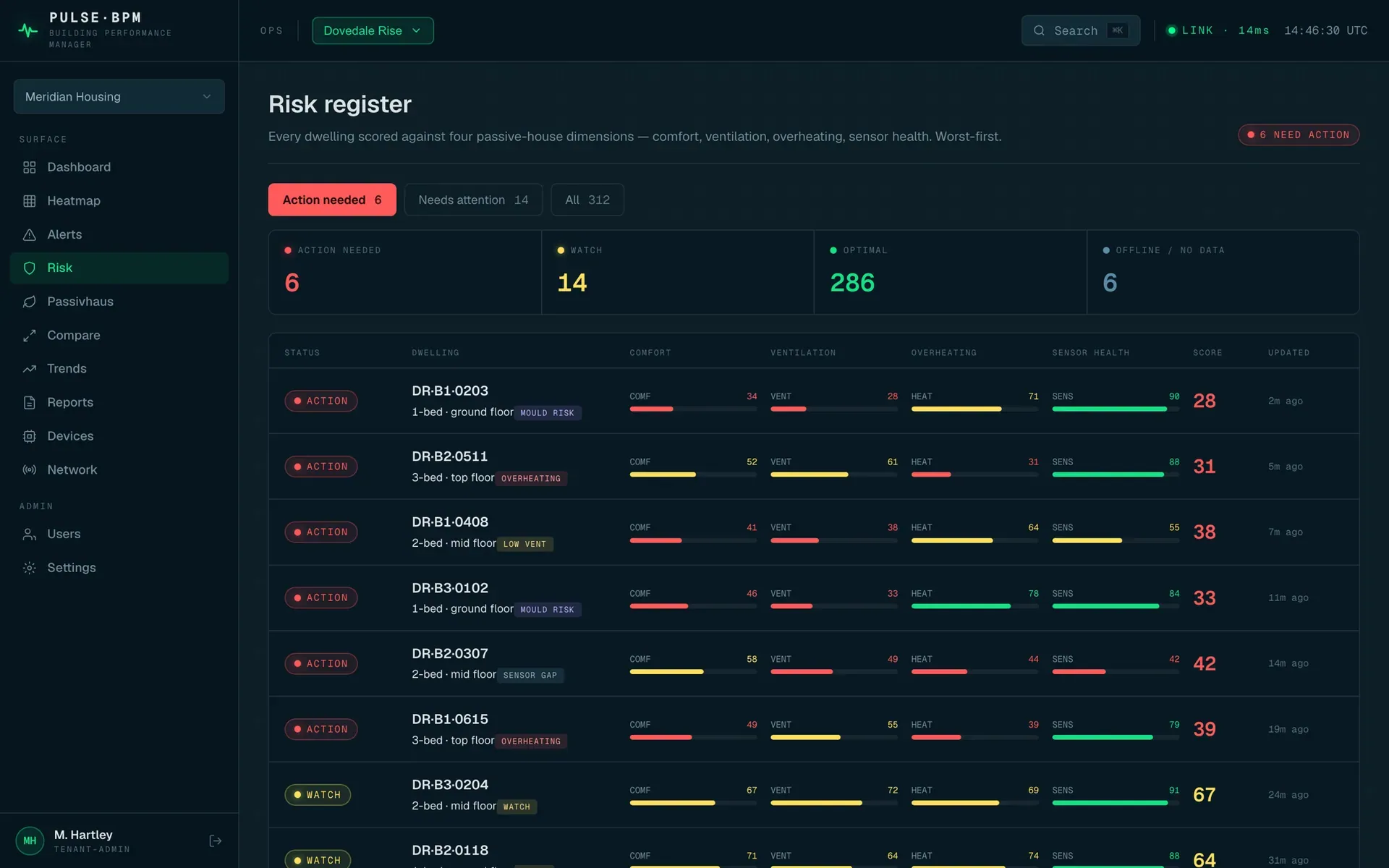
Pulse calculates surface condensation risk continuously from air temperature and relative humidity in each monitored room, using a method consistent with Awaab's Law obligations and HHSRS guidance. Dwellings that exceed the risk threshold are ranked worst-first in the risk register and flagged for investigation. Every flag is timestamped with the sensor readings that triggered it, so the evidence exists before a complaint is made.
For certified Passivhaus buildings, Pulse tracks measured space-heating demand, primary energy, and indoor comfort conditions against the design-stage PHPP targets. The comparison view shows the performance gap as a number, per thermal envelope, updated as the data accumulates. Where the gap is large, the platform surfaces the dwellings and periods that are driving it.
CO2 concentration is the most practical proxy for ventilation adequacy in a residential building. Pulse tracks CO2 at room level and flags persistent elevated readings as potential MVHR faults, commissioning errors, or occupancy anomalies. Where air quality sensors report PM2.5 or VOC levels, those feeds integrate into the same dwelling-level view.
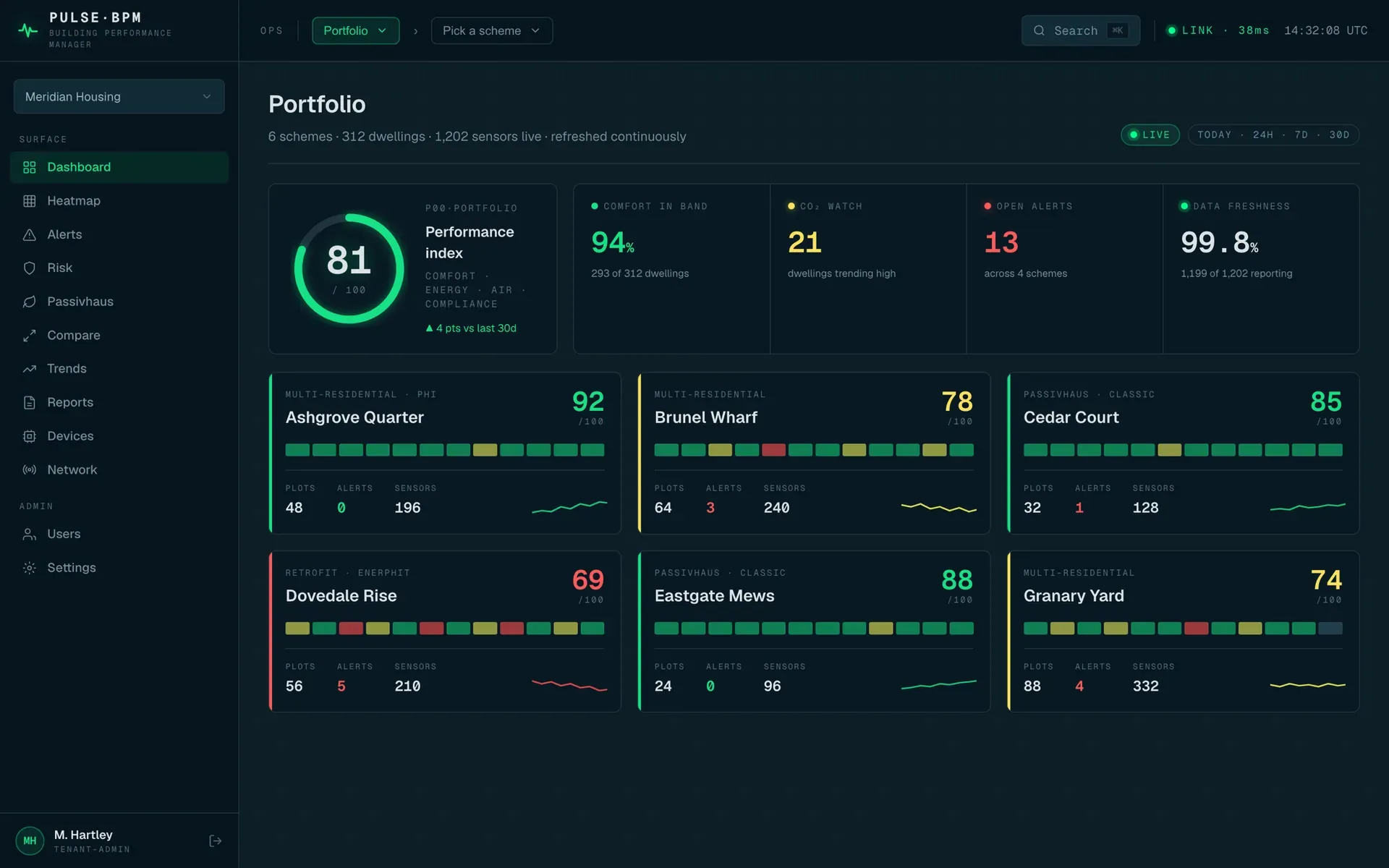
Every scheme, colour-coded for compliance, right now.
The portfolio view gives every scheme a live compliance colour: green is in band, amber is on watch, red needs action. One screen for the board, showing the compliance status of every scheme simultaneously. Click any cell to drill to scheme, block, dwelling and room level.
Common questions.
03 / FAQWhat is post-occupancy evaluation and why does it matter?
Post-occupancy evaluation (POE) is a structured measurement of how a building actually performs once people are living or working in it, compared to the design intent. The performance gap between a certified building's PHPP model and its measured energy and comfort in use has been well-documented in research across Europe and internationally. POE closes that loop: it identifies where the gap is, how large it is, and what is causing it, whether that is a construction quality issue, a commissioning fault, an occupancy difference, or a design assumption that needs revision.
What compliance standards does Pulse support for POE?
Pulse supports overheating compliance assessment to CIBSE TM52 (non-domestic) and TM59 (domestic), including continuous exceedance-hour calculation and criterion tracking. For damp and mould risk, Pulse scores each dwelling continuously using a method consistent with Awaab's Law requirements and HHSRS guidance. Passivhaus in-use compliance views cover space-heating demand, primary energy, n50 airtightness (from the blower-door test record) and fabric heat-loss, compared against the design-stage PHPP targets.
What is the Whitehaven proof project?
Whitehaven is a multi-residential scheme where Pulse is deployed with approximately 1,100 sensors across the development. It is the platform's most extensively monitored deployment and represents the scale at which Pulse's portfolio-to-room hierarchy and data-quality architecture were validated in a live operational context. It is a reference project for the platform's capability at housing-association scale.
How does Pulse surface mould risk in practice?
Pulse calculates surface condensation risk continuously from the air temperature and relative humidity readings in each room. Where the calculated risk exceeds the threshold consistent with Awaab's Law obligations, the dwelling is flagged in the risk register and ranked worst-first. The facilities manager sees the at-risk dwellings on their next login, with timestamped evidence of the condition, before a complaint or an inspection triggers the issue.
See POE on a live portfolio.
A walkthrough of Pulse's compliance views on a real monitored portfolio. No slides, no mock data.