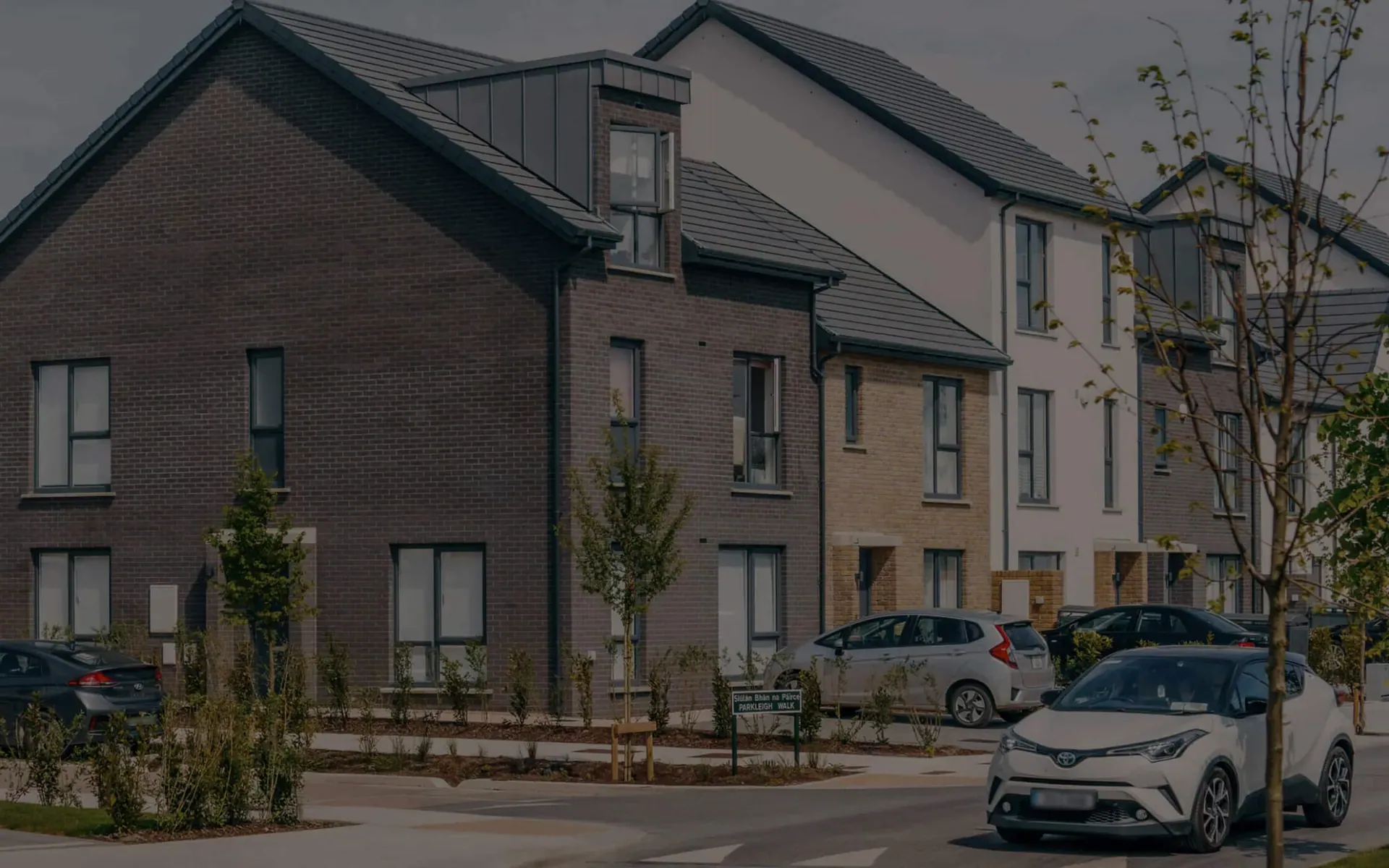
Passivhaus, on home ground.
Ireland is where Mosart began, where the first certified Passivhaus in the English-speaking world was built, and where the standard is moving from niche to mainstream. Around 7% of new homes here are now built to it.
We are an Irish practice, based in Wicklow, and Ireland is the market we know best. It is also the one moving fastest. The first certified Passivhaus in the English-speaking world was built here in 2004, we wrote the country’s national Passive House guidelines, and the standard has since gone from a handful of houses to whole new towns.
From one house to the mainstream.
nZEB and Part L
Every new home must meet the nearly zero-energy standard under Part L, an A2 BER. Passivhaus clears that with room to spare, and one PHPP model covers both, so there is no separate compliance run.
Climate Action Plan
Public bodies carry decarbonisation targets, and the Pathfinder programme retrofits their own stock as demonstrators. We are Design Team Lead on the Leitrim, Galway and Mayo Council Pathfinders.
Developers are adopting it
Cairn, the largest homebuilder in the country, has committed to Passivhaus across its pipeline, and councils and housing bodies are specifying it for new schemes. Around 7% of new homes are now built to the standard.
The guidelines, written here
The first certified Passivhaus in the English-speaking world was built in Wicklow in 2004. Mosart’s founder designed it and went on to write Ireland’s national Passive House guidelines.
That number would have been a rounding error a decade ago. The shift has been driven by the people who carry the long-term cost of a building, social landlords, public bodies and the larger developers, finding that a certified standard is cheaper to run, easier to let and simpler to stand over than a building that only meets the minimum.
We have been part of that shift from the start, as architect, as Passivhaus designer and as certifier, on schemes from a single home to a town of 5,500.
Delivered across Ireland.
From a 5,500-home new town in Dublin to social housing in Wicklow and civic retrofits in Leitrim, Galway and Mayo, the Irish track record is the evidence that the standard works at every scale. Cairn, the country's largest homebuilder, has committed to Passivhaus across its pipeline, and we work across its schemes: independent certifier at Seven Mills, Passivhaus designer at Pipers Square and Whitehaven, Passive House consultant at Niven Oaks. Appoint a Passivhaus designer or consultant in Ireland from feasibility through to certification.
Common questions.
FAQIs Passivhaus mandatory in Ireland?
No. Every new home has to meet the nearly zero-energy building (nZEB) standard under Part L, which in practice means an A2 BER. Passivhaus is voluntary and sits above that. What has changed is how many people now choose it: the largest homebuilders, several local authorities and a growing number of private clients specify Passivhaus because it gives them a performance they can prove, not just a rating on paper.
How does Passivhaus relate to nZEB and Part L?
A Passivhaus Classic dwelling clears the Irish nZEB and Part L requirements comfortably. Passivhaus does not make the regulatory submission irrelevant: Part L compliance and the BER are still demonstrated through DEAP, the national methodology, as on any other project, and PHPP sits alongside it rather than replacing it. What changes is the margin. Designing to the Passivhaus fabric standard means you clear Part L with room to spare and hold an independently certified performance on top, rather than just meeting the minimum. We run the PHPP model and the DEAP assessment together, so the compliance route and the Passivhaus target stay aligned.
How common is Passivhaus in Irish new builds now?
Around 7% of new homes in Ireland are now built to Passivhaus, and the share is rising year on year. Cairn, the largest homebuilder in the country, has committed to the standard across its pipeline, and public bodies are retrofitting their own stock to it under the Climate Action Plan. The standard has moved from a handful of one-off houses to schemes of several thousand homes.
Did Passivhaus really start in Ireland?
The first certified Passivhaus in the English-speaking world was built in Ireland, in County Wicklow, in 2004. It was designed by Tomás O’Leary, who went on to co-found Mosart and to write Ireland’s national Passive House guidelines. Twenty years on, the country has gone from that single house to certifying the homes of a 5,500-home new town.
Can Passivhaus be delivered at scale in Ireland?
Yes, and the evidence is on the ground. Mosart is Passivhaus certifier on Seven Mills in Dublin, a new town of 5,500 homes, Passive House designer on the 550-home Shanganagh Castle scheme, and consultant on Niven Oaks for Cairn. At scale the work is a set of details repeated correctly across hundreds of homes, and the cost premium falls as the details repeat.
What about retrofit and the public sector?
Ireland’s Pathfinder programme has public bodies retrofitting their own buildings as demonstrators under the Climate Action Plan, targeting a 50% cut in carbon and energy and a minimum BER of B. We are Design Team Lead on the Leitrim, Galway and Mayo Council Pathfinders, including the deep retrofit of protected structures. EnerPHit, the Passivhaus retrofit standard, applies the same building physics to existing stock.
Building in Ireland?
Wherever the scheme is and whatever the scale, the first conversation is the same: what you are building, and what it has to achieve.