From first sketch to buildable envelope.
Architects who think in building science. Engineers who value design.
Concept through planning submission to full construction documentation, coordinated with structure, services and the building physics that underpins every specification. The airtightness line stays continuous, the thermal envelope has no gaps, and the contractor gets drawings they can build from.
What planning and detailed design delivers.
What it isMost building failures, whether they show up as a failed airtightness test, a missed Passivhaus certification or a thermal bridge that the certifier cannot accept, originate in the drawing set: an airtightness line that was never drawn, a break in the thermal envelope nobody spotted, a window installation left to a standard spec sheet. The contractor then makes reasonable assumptions that turn out to be wrong.
We produce construction documentation where the Passivhaus criteria are explicit in every relevant drawing: the airtightness strategy is shown in plan, section and detail; thermal bridges are analysed to BS EN ISO 10211 before the structural details are issued; window schedules include measured U-values and g-values for PHPP; and service penetrations through the envelope are coordinated before the build starts.
The result is a building that the contractor can actually build to the standard, because the standard has been modelled in PHPP and represented on the drawings.
PHPP model live from Stage 1. Thermal bridge analysis completed at Stage 3, before structural details are fixed. Airtightness strategy drawn and checked at Stage 4. Pre-completion airtightness test coordinated at Stage 5. The performance target is tracked at every stage, not checked at the end.
U-values calculated to BS EN ISO 6946. Thermal bridges calculated to BS EN ISO 10211. Airtightness tested to EN ISO 9972. Window U-values and g-values to EN ISO 10077 and EN 410. All values entered into PHPP for certification.
How we work at each RIAI stage.
MethodThe PHPP model is open from the first design meeting. As the concept develops, we test the energy consequences of each design decision: changing the building depth, moving the stair core, adding a rooflight. The model is not a constraint on design; it is a tool that tells the design team what each choice costs in energy terms, so the trade-offs are explicit.
At Stage 3, the structural system is becoming fixed. This is the last stage at which thermal bridges can be redesigned without significant cost. We run a thermal bridge audit of every distinct junction type to BS EN ISO 10211, identify any junction that will not meet the Passivhaus threshold, and coordinate redesign options with the structural engineer. The planning application is submitted with an energy statement based on the developed PHPP model.
The full construction documentation package includes: the airtightness strategy drawing showing the continuous line in every plan and section; the junction catalogue from thermal bridge analysis; the window installation detail showing thermal break position; penetration details for all services; and the PHPP model at construction level, updated with measured values from the specified products. Every drawing is reviewed by a PHI-accredited certifier before issue to contractor.
We inspect the envelope at key stages, particularly at the point where the airtightness membrane is complete but before internal finishes cover it. An intermediate airtightness test at this stage allows any defects to be traced and repaired before they are inaccessible. The pre-completion test is coordinated with the PHI certifier, who will require the result as part of the certification application.
In practice: Senan House.
Evidence Ireland's first certified Passivhaus office.
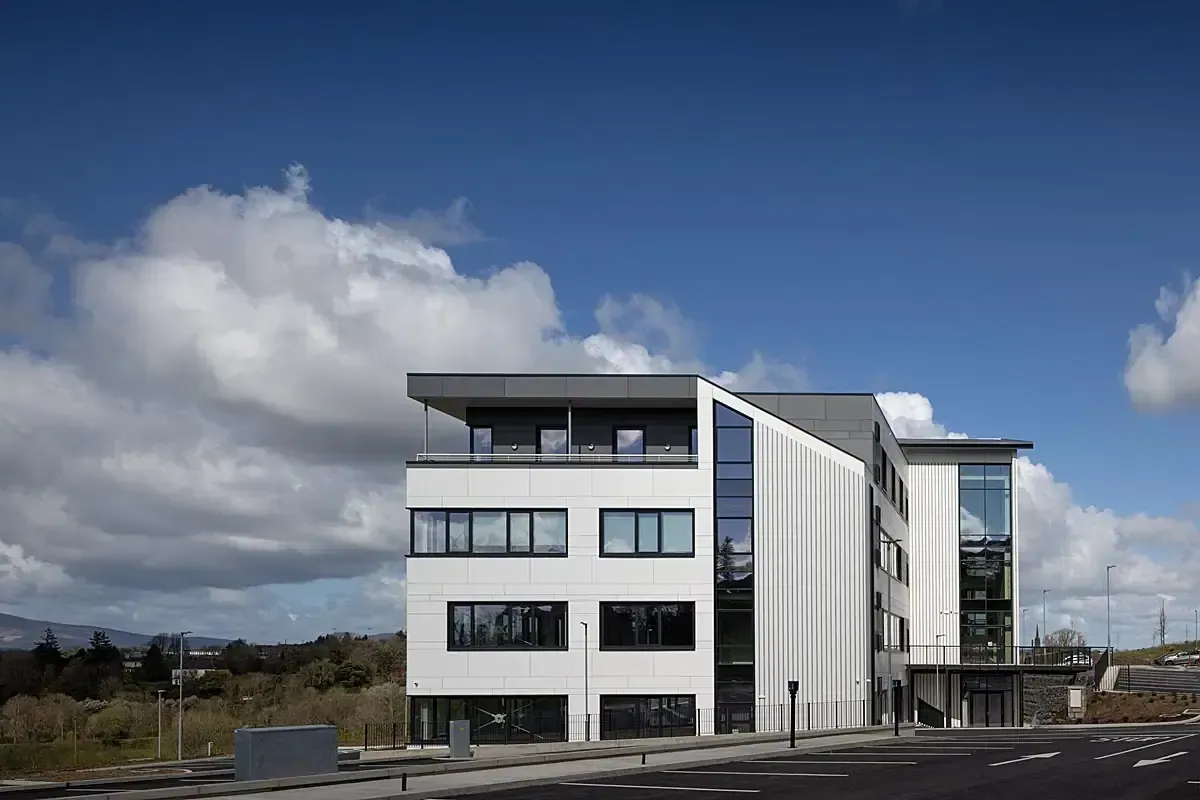
Senan House in Enniscorthy, Wexford, is Ireland's first certified Passivhaus office building, designed and certified by Mosart. The project demonstrates the full architectural service from feasibility through to completion: PHPP from Stage 1, thermal bridge analysis completed before the structural documentation was issued, and an airtightness strategy drawn into every plan and section of the construction package.
The project was awarded most sustainable project in 2024 and demonstrates that Passivhaus office design is achievable within a standard commercial programme and budget when the physics is embedded from the start.
See the Senan House case study →Common questions.
FAQWhat does RIAI Stage 1 to 5 cover for a Passivhaus project?
RIAI Stage 1 is feasibility and brief. Stage 2 is concept design. Stage 3 is developed design and planning submission. Stage 4 is construction documentation, tender and procurement. Stage 5 is construction and site inspection. For Passivhaus, the PHPP energy model is live from Stage 1, thermal bridge analysis is completed at Stage 3 before structural details are fixed, and the airtightness strategy is drawn and coordinated at Stage 4 so the contractor has a buildable layer to follow on site.
What is the airtightness line and why does it need to be drawn?
The airtightness line is a continuous barrier around the thermal envelope of the building that prevents uncontrolled air leakage. In a Passivhaus building it must achieve 0.6 ACH at 50 Pa on a pressure test. This line must be drawn explicitly on every plan, section and junction detail, because gaps and breaks in the line on paper become gaps and breaks in the building. An airtightness strategy that is left to the contractor to figure out on site will not achieve 0.6 ACH. We draw the line in every drawing set.
How is structural coordination different for Passivhaus buildings?
In a standard building, the structural engineer details connections and the architect provides the insulation as a separate layer. In a Passivhaus building, the thermal envelope must be continuous across every structural junction: a concrete slab edge, a column penetrating insulation, a balcony connection. These must be coordinated between architect and structural engineer at Stage 3 or earlier, because the structural system directly determines the thermal bridge performance. We run thermal bridge analysis alongside structural design, not after it.
What construction documentation does a Passivhaus project need beyond a standard set?
Far less than people expect. A Passivhaus set is a well-detailed construction set with the airtightness line and the key thermal-bridge details made explicit on the drawings we would produce anyway. Beyond a standard set, the only genuinely extra items a project needs are a whole-building airtightness test and a signed contractor’s declaration that the building was constructed as specified. Both come at the end and are reviewed by a PHI-accredited certifier. The standard adds rigour to the documentation, not a pile of new paperwork.
Start a project.
Tell us the building type, scale and programme. We will tell you what the Passivhaus standard requires at each RIAI stage and what the drawing set will need to include.