Passivhaus and the London Plan.
The London Plan asks every major scheme to be lean, clean, green and seen. Passivhaus is the strongest answer to the first step, and our Pulse monitoring closes the last.
London has the toughest energy-and-carbon planning rules in these islands, and they line up closely with how Passivhaus already works. The London Plan’s energy hierarchy, its overheating policy and its Be Seen monitoring requirement all point the same way: less demand, measured in use. We work on London schemes at height and density, including 2 Trafalgar Way in Canary Wharf.
The energy hierarchy, step by step.
Be Lean, Clean, Green, SeenUse less energy
The first and most heavily weighted step, and the one a Passivhaus fabric standard answers better than anything else: ultra-low U-values, continuous airtightness, thermal-bridge-free junctions and heat recovery cut regulated demand at source, before any plant or renewables are counted.
Supply energy efficiently
With demand already low, the heat strategy gets simpler and smaller. We model connection to heat networks where required and size systems to a building that needs very little, rather than oversizing for a leaky one.
Use renewable energy
A Passivhaus needs less renewable capacity to hit the on-site carbon target, which frees roof area and capital, and shrinks the residual carbon that has to be met by an offset payment to the borough fund.
Monitor in use
Major schemes must report metered performance to the GLA for five years after occupation. Our Pulse platform measures energy, comfort and air quality continuously, so the Be Seen submission falls out of monitoring you are already doing.
The other London tests we design to.
PolicyOverheating, Policy SI 4
Dynamic thermal modelling to CIBSE TM52 and TM59, following the cooling hierarchy. We assess and limit overheating from the first PHPP model, which matters most on the tall, glazed, high-occupancy schemes London builds.
Whole life-cycle carbon
Referable applications need a WLC assessment of embodied and operational carbon. Very low operational demand improves the whole-life number, and we coordinate the operational side through the energy model.
Part L and the Future Homes Standard
The 2021 Part L uplift and the Future Homes Standard, published in March 2026 and in force from 2027, move England toward where Passivhaus already sits. Designing to the standard now settles compliance for a multi-year London pipeline rather than chasing it.
Energy statements that hold up
A GLA energy assessment is only as good as the numbers behind it. A PHPP model built to construction level, by the team that will certify it, gives a submission that stands up to scrutiny and an as-built that matches.
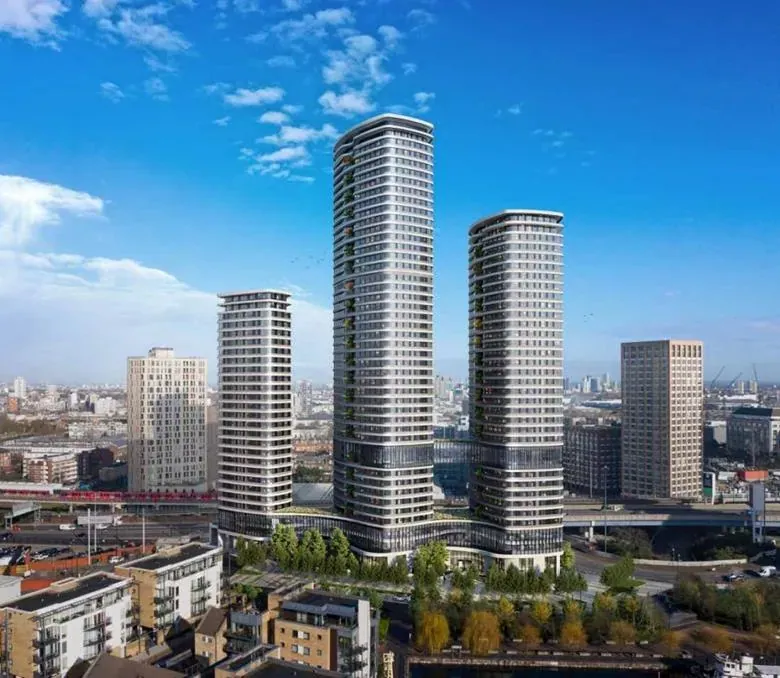
2 Trafalgar Way, Canary Wharf.
Three towers of up to 46 storeys: 1,672 student bedrooms and 80 apartments, targeting Passivhaus certification and BREEAM Outstanding. Certified at that scale, it would be the largest Passivhaus development in Europe. Height changes the physics, and we work it out once for the whole scheme. Elsewhere in the city we are co-Passivhaus designer on the Urbanest student towers at Nine Elms. You can appoint a Passivhaus designer or Passive House consultant in London, from feasibility through to independent certification.
Common London Plan questions.
FAQHow does Passivhaus help meet the London Plan energy requirements?
The London Plan requires major development to follow the energy hierarchy: Be Lean, Be Clean, Be Green, Be Seen. Passivhaus is a strong answer to "Be Lean", the first and most heavily weighted step, because it cuts regulated energy demand through fabric and form before any plant is added. A building that starts from a Passivhaus fabric standard reaches the London Plan’s on-site carbon targets with less reliance on renewables and a smaller offset payment, and the performance is measured rather than modelled on paper.
What is the "Be Seen" requirement, and how do you meet it?
Be Seen is the London Plan’s post-construction stage: major developments must report actual metered energy performance to the GLA for at least five years after occupation, through the Be Seen energy monitoring platform. It exists because designed performance and in-use performance often diverge. Our Pulse service is made for this. It monitors energy, comfort and air quality continuously, with the source recorded on every reading, so the Be Seen submission comes straight from monitoring the building is already doing.
Does the London Plan require whole life-cycle carbon assessment?
Yes. Referable applications must submit a Whole Life-Cycle Carbon (WLC) assessment covering embodied and operational carbon across the building’s life. Passivhaus does not directly govern embodied carbon, but its very low operational demand improves the whole-life picture substantially, and a fabric-first approach tends to favour lower-carbon, durable construction. We coordinate the operational side of the WLC assessment through the PHPP model.
How does the London Plan handle overheating?
Policy SI 4 requires major development to demonstrate it has reduced overheating risk following the cooling hierarchy, with dynamic thermal modelling to CIBSE TM52 and TM59 for residential. High-density London schemes, especially student accommodation and tall residential, are where overheating is hardest to control. Passivhaus requires overheating to be assessed and limited at design stage as a matter of course, so we design to meet the London Plan test from the first model rather than fixing it at planning.
Has Mosart delivered Passivhaus at London scale?
Yes. Mosart is Passivhaus designer on 2 Trafalgar Way in Canary Wharf, three towers of up to 46 storeys delivering 1,672 student bedrooms and 80 apartments, targeting Passivhaus certification and BREEAM Outstanding; certified at that scale it would be the largest Passivhaus development in Europe. We have also worked on Urbanest schemes in London. We understand both the standard and the specific demands of London planning at height and density.
How does Passivhaus reduce the carbon offset payment?
Where a development cannot reach net-zero-carbon on site, the shortfall is met through a cash-in-lieu payment to the borough’s carbon offset fund, typically priced per tonne of CO2 over 30 years. Because Passivhaus cuts regulated energy demand so far at the Be Lean stage, the residual carbon that has to be offset is smaller, which can materially reduce the offset payment over a large scheme. We model this trade-off at feasibility so it informs the energy strategy rather than surprising the budget at planning.
Building in London?
Bring us in at feasibility and the energy hierarchy, overheating and Be Seen are designed in from the first model rather than bolted on at planning.