Proof, not promise.
Mosart designs, certifies and then monitors buildings in use. The measured evidence from each completed building feeds into the design decisions for the next one. This is the proof loop.
The proof loop.
01 / The approachMosart has been designing and certifying Passivhaus buildings since 1993. The practice produced the first certified Passivhaus in the English-speaking world. Over thirty years, the design team has accumulated a body of measured knowledge about what the standard demands in practice, which details hold, which assumptions prove optimistic, and where the performance gap between the PHPP model and the occupied building is most likely to appear.
Pulse is where that knowledge becomes systematic. The platform connects the completed building back to the design team: live sensor data, quality-flagged, traceable, available for analysis against the original PHPP targets. When a completed Passivhaus building is monitored with Pulse, the findings from year one inform the design decisions for the next project in the practice's pipeline.
A single organisation designs, certifies and then measures. The design decisions on each new project are calibrated by the evidence of what was actually built before it, and how it performs with people living in it.
Mosart has been designing and certifying Passivhaus buildings since 1993, including the first certified Passivhaus in the English-speaking world. Thirty years of measured evidence, now formalised in the Pulse platform.
Mosart is accredited by both the Royal Institute of the Architects of Ireland (RIAI) and the Passive House Institute (PHI). Design, certification and post-occupancy monitoring in one accredited practice.
Four steps, one loop.
02 / How it worksThe building is modelled in PHPP from concept. Every design decision, form factor, orientation, fabric specification, window performance, ventilation strategy, produces a predicted space-heating demand, overheating hours, primary energy figure. The design targets are set against the PHI Passivhaus standard or the applicable project brief.
On completion, the building is certified. The blower-door test result is recorded. The as-built PHPP is reconciled against the design-stage model: where the construction differed from the specification, the model is updated to reflect what was actually built. The certification record is the baseline against which in-use performance is subsequently measured.
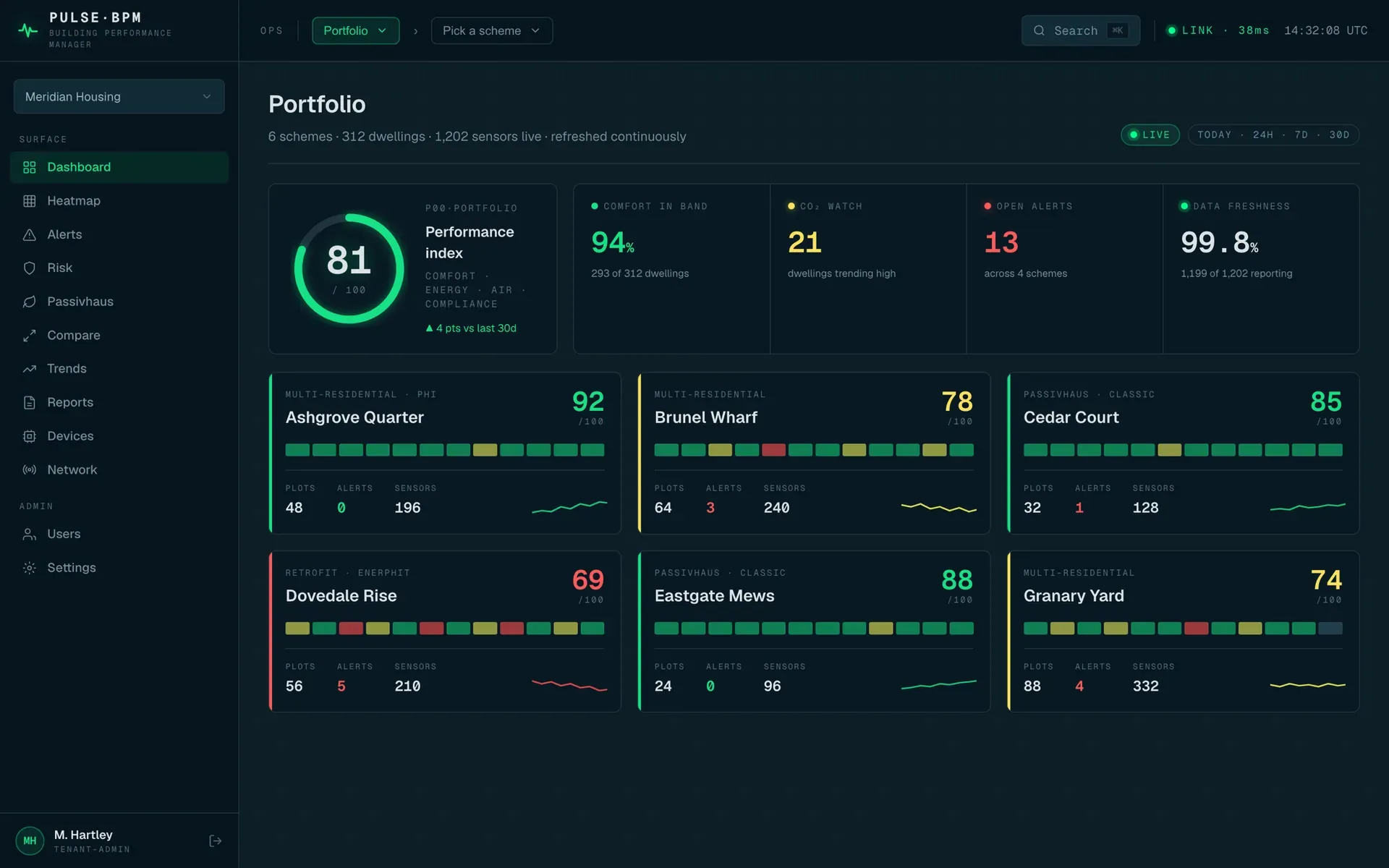
Pulse connects to the sensor network already in the building, or to sensors added at handover. From the first day of occupation, temperature, humidity, CO2, energy and water data flows continuously into the platform. The comparison view overlays measured performance against the certified targets. Where the gap appears, the platform identifies which dwellings and which periods are driving it.
The findings from year one and year two of monitored occupation are reviewed by the design team against the PHPP assumptions that were used at design stage. Where the measured data reveals a consistent pattern, a design assumption that over-estimated solar gain, an MVHR commissioning issue that recurs in a particular system type, a junction that consistently underperforms the modelled psi-value, that finding becomes input to the next project's design assumptions. The proof loop closes.
What the proof loop means for you.
03 / For clientsTimestamped evidence, not a design certificate
Pulse produces board-level compliance reports backed by continuous sensor data. When a funder, a regulator or an insurer asks for evidence that the building meets the standard it was certified to, the answer is a Pulse export, quality-flagged and reproducible.
Calibrated PHPP assumptions
The most common source of design error in low-energy buildings is not calculation mistakes in PHPP, it is optimistic inputs. Pulse provides the measured data to identify which inputs were optimistic and by how much, so the next model starts from a more accurate baseline.
Procurement evidence for future schemes
Measured in-use performance data from a completed scheme is hard evidence for justifying the specification level of a future procurement. Pulse makes that evidence available in a form that can be presented to committees, funders and auditors.
Common questions.
04 / FAQWhat is the proof loop and why does it matter?
The proof loop is the cycle that connects measured performance in one building to better design decisions in the next. Design a building, certify it, monitor it in use, measure the performance gap, and feed those findings back into the design assumptions for the next project. Mosart closes this loop by combining the design and certification practice with the Pulse monitoring platform: the same team that set the targets measures whether they were met, and revises the approach accordingly. This is what proof over promise means in practice.
How does monitored evidence improve the next building's design?
Design-stage assumptions about occupancy patterns, ventilation rates, solar gain and heating schedules are, by necessity, estimates. When measured data from a completed building shows that a particular design assumption was consistently wrong, the next PHPP model can be calibrated with a better starting point. This is particularly valuable for details and junctions where the as-built condition differed from the modelled one, and for systems where commissioning or occupant behaviour drove the performance gap.
What does "proof over promise" mean for a housing association or developer?
It means that the performance claims for a completed scheme are backed by timestamped measured data rather than the design certificate alone. When a housing association needs to demonstrate to a funder, a regulator or a tenant that a building meets Passivhaus, Part O or Awaab's Law standards, Pulse provides the evidence: continuous readings, quality-flagged, with a known provenance chain, available as a board-level report or a raw data export.
Is Mosart's own design practice monitored with Pulse?
Mosart's approach is to design, certify and then measure. The integration of design practice, certification capability and the Pulse monitoring platform in a single organisation means that the measured performance of completed Mosart buildings informs the design decisions on the next ones. This is the differentiator: not a monitoring product sold independently, but a feedback loop built into the practice's methodology.
See the proof loop on a live portfolio.
A walkthrough of Pulse on a real monitored portfolio, from the design targets to the measured performance, and what the gap tells the design team.