Passivhaus and the Future Homes Standard.
England published the Future Homes Standard in March 2026, and it lands for new homes in 2027. Passivhaus already sits beyond it. Design to the standard now and compliance is settled with room to spare, then proven on the finished building.
Each uplift to the Building Regulations asks new buildings in England to use less energy and carry less carbon. The Future Homes Standard, published in March 2026 and in force from 2027, is the next big step: a new home that is zero-carbon ready, heated without gas, built to roughly 75 to 80 percent less carbon than the 2013 rules. Passivhaus has worked to targets like these for thirty years. It settles compliance for a multi-year pipeline instead of a redesign at every step, and backs the numbers with a certificate and a tested building. We work across England, from one-off homes to student accommodation at the University of Manchester and towers in London.
Where the rules are heading.
Part L to the Future Homes StandardPart L, today
New homes already work to a tighter fabric and carbon standard than a decade ago, with SAP at the centre of the submission. A Passivhaus design clears it comfortably, because the demand is cut at the fabric before any plant is counted.
The Future Homes Standard
Every new home must be zero-carbon ready: a heat pump in place of a gas boiler, solar PV, and fabric well above the old baseline. A Passivhaus is built for this. The heat demand is small enough that a modest heat pump finishes the job, with no late redesign when the rule bites.
As-built evidence
Part L now asks for photographic records and a BREL report, because designed and real performance so often diverge. Passivhaus confirms the result on the finished building, with a physical airtightness test rather than an assumed figure.
A standard you can prove
Compliance shows a building was allowed to be built. Certification shows it performs. Our Pulse monitoring then checks the in-use numbers against the model, so the case for the next scheme rests on evidence.
The other English tests we design to.
PolicyOverheating, Approved Document O
New residential buildings must show they have limited overheating risk, by the simplified method or dynamic modelling to CIBSE TM59. We assess and design it out from the first PHPP model, where it matters most on tall, glazed, high-occupancy schemes.
The existing stock and MEES
Minimum energy efficiency standards keep tightening for rented property, and the case for deep retrofit grows with them. EnerPHit, the Passivhaus retrofit standard, brings the same building physics to existing buildings without guesswork.
Councils and clients specifying it
Local authorities now ask for Passivhaus or EnerPHit on their own housing, and the standard has produced some of England’s most recognised recent buildings. Procurement is moving the same way as policy.
Energy strategies that hold up
A submission is only as good as the model behind it. A PHPP model built to construction level, by the team that will certify the building, gives an energy strategy that stands up to scrutiny and an as-built that matches.
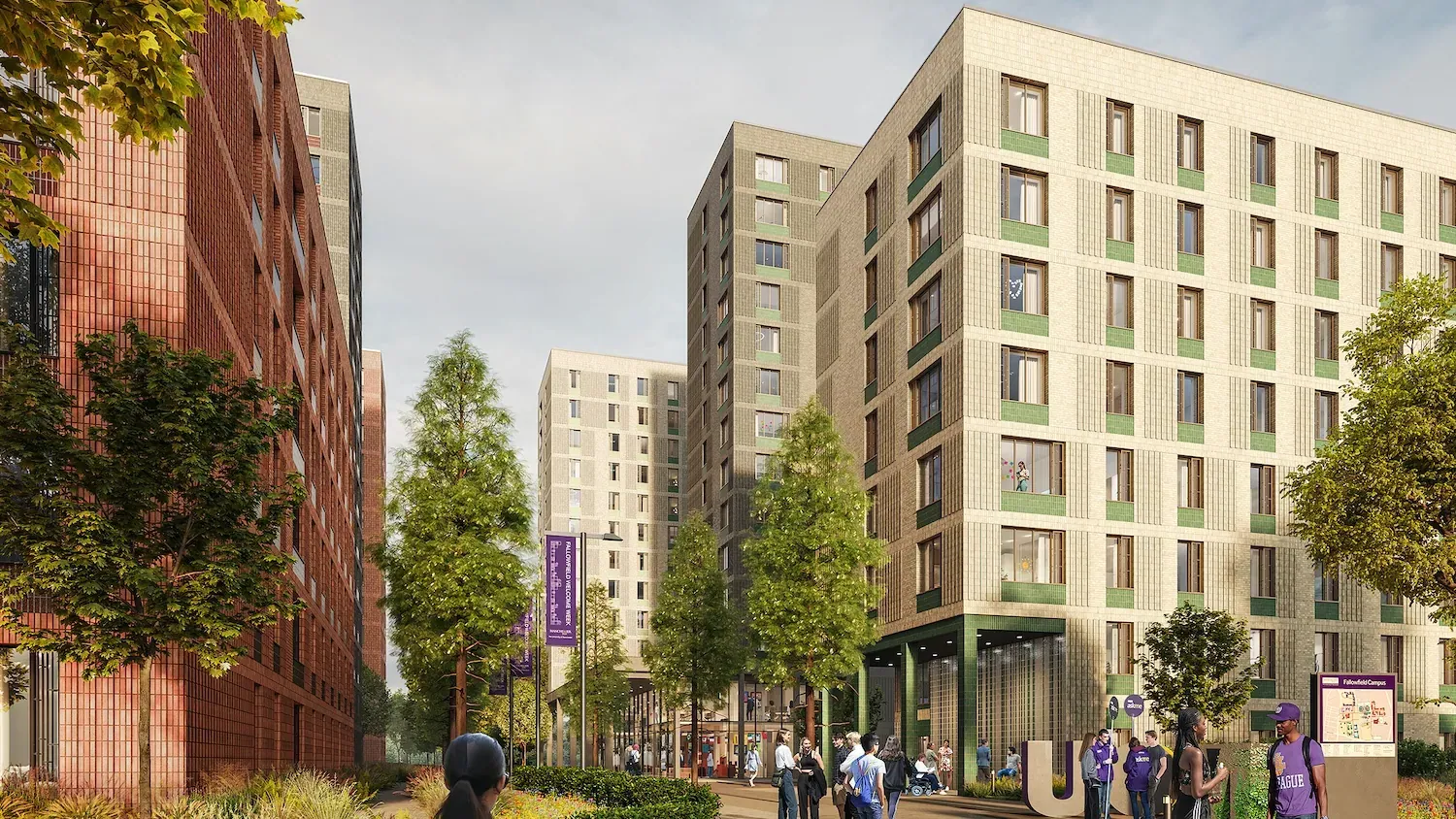
University of Manchester, Fallowfield.
New student accommodation for the University of Manchester, where we are Passive House design consultant. Student schemes are dense, heavily serviced and lived in hard, which is exactly where fabric-first performance and careful overheating control earn their keep. In London we work at height too: Passivhaus designer on the towers at 2 Trafalgar Way in Canary Wharf, and on the Urbanest scheme at Nine Elms. The same building physics holds whether it is a single house or a residential tower. You can appoint a Passivhaus designer or Passive House consultant in England, from feasibility through to independent certification.
Common questions for England.
FAQHow does Passivhaus relate to the Future Homes Standard?
The Future Homes Standard sets the next step for new homes in England: low-carbon heating instead of gas, and a fabric standard well above today’s baseline. Passivhaus already sits above where the standard is heading, and it pairs naturally with a heat pump because the heat demand is so small to begin with. Designing to Passivhaus now means a project is built for the standard rather than caught out by it, and you hold an independent performance certificate that a SAP rating on its own does not give you.
Does Passivhaus replace Part L compliance?
No. Part L is still demonstrated the normal way, through a SAP assessment and the as-built evidence the regulations ask for. Passivhaus does not remove that step. What it changes is the margin: a building designed to the Passivhaus fabric standard clears Part L comfortably, and the PHPP energy model runs alongside the SAP submission rather than in place of it. You meet the regulation with room to spare, and you can prove the performance on top.
How does England deal with overheating now?
Approved Document O, in force since 2022, requires new residential buildings to show they have limited overheating risk, either through the simplified method or by dynamic thermal modelling to CIBSE TM59. Overheating is hardest to control on the tall, glazed, high-occupancy buildings that cities are building most of. Passivhaus requires overheating to be assessed and designed out from the start, so we test it in the first model rather than discovering it at planning.
Why does the performance gap matter under the new rules?
England’s Part L now asks for as-built evidence, including photographic records and a BREL report, because designed performance and real performance so often diverge. Passivhaus closes that gap by design: the airtightness target is confirmed by a physical pressure test, components are entered at certified values rather than defaults, and the standard is verified on the finished building. We also keep measuring after handover through Pulse, so the in-use numbers can be checked against the model.
Are English councils and clients actually asking for Passivhaus?
Increasingly, yes. Several local authorities now require Passivhaus or EnerPHit for their own housing, and the standard has produced some of England’s most recognised recent buildings, including a Stirling Prize-winning council scheme in Norwich and large Passivhaus developments in London and the North. The direction of travel in policy and in procurement is the same one Passivhaus has followed for thirty years: less demand, measured in use.
Has Mosart delivered Passivhaus in England?
Yes. We are Passive House design consultant on the University of Manchester’s Fallowfield student accommodation, and in London we are Passivhaus designer on 2 Trafalgar Way in Canary Wharf and have worked on Urbanest schemes. We work across England at the height and density its cities build, and we bring the same building physics whether the project is a house or a tower.
Building in England?
Bring us in at feasibility and the fabric, the heat strategy and overheating are settled from the first model, ahead of the standard rather than chasing it.