Pulse · BPM · Building Performance Manager
The building has a pulse. Now you can see it breathing in real time.
Pulse connects to the sensors already in your buildings and shows, live, whether each home is warm, dry, well ventilated and affordable to run, and which ones need attention today. Built for Passivhaus and low-energy housing, and it reads as clearly to a housing officer as to a building physicist.
What Pulse actually does.
The building reports in
Small wireless sensors, the kind most new schemes already have, measure temperature, humidity, CO₂ and energy use in each home. No new cabling.
Every home gets a daily read
Pulse turns the readings into a simple status per home: fine, watch, or needs action. Too cold, too damp, stale air or unusual energy use shows up without a site visit.
Your team fixes the worst first
The day’s priority list says which homes need attention and why. Every reading is kept and timestamped, so you can show a board, a regulator or a tenant what happened and when.
Most building software predicts how a building should perform before it is built. Pulse measures the kept promise, not the design-stage one: how your buildings are performing now, while people live in them.
The board, the facilities manager and the building scientist all read the same underlying data.
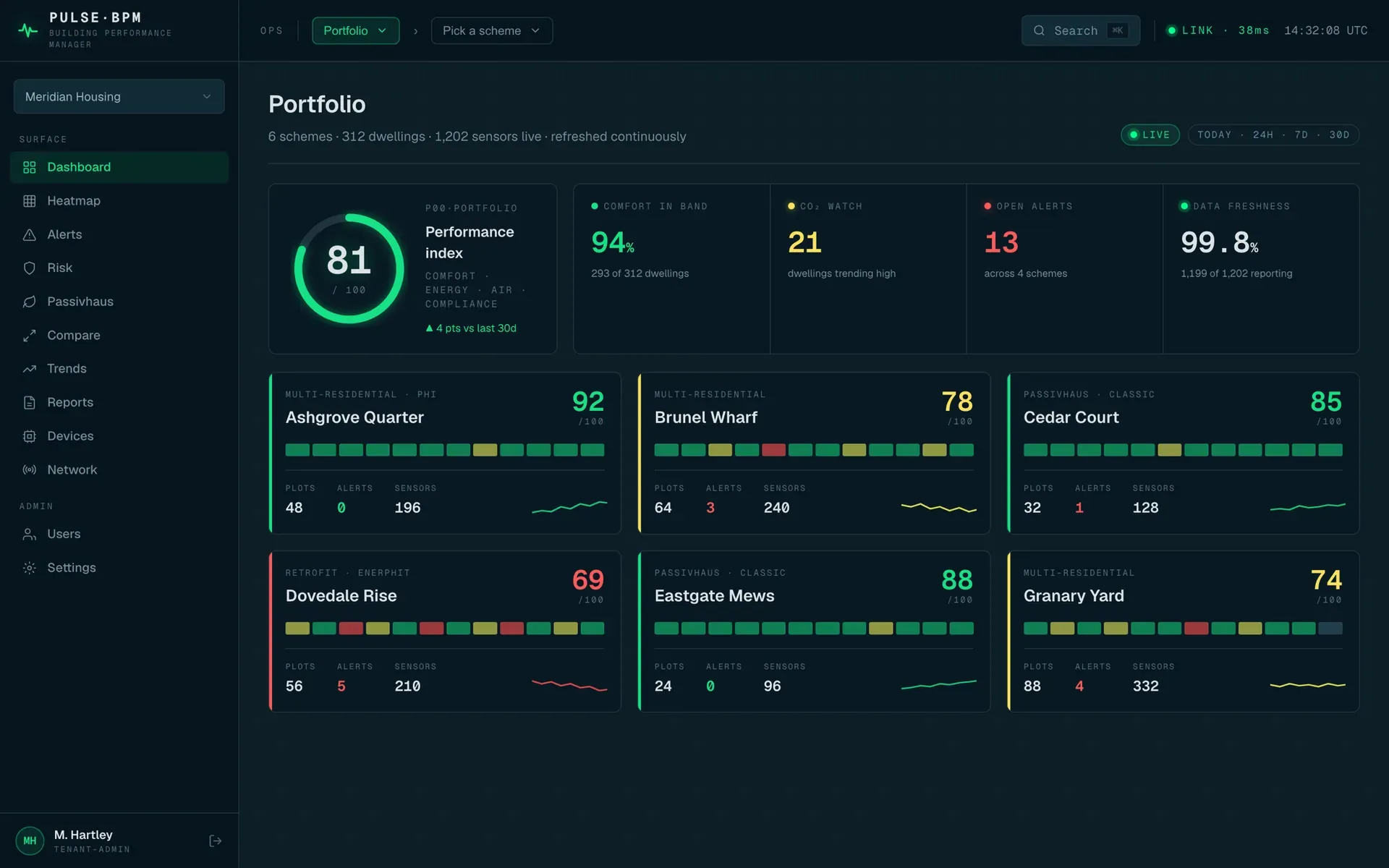
A portfolio compliance score
One defensible, timestamped number per scheme, today.
Today’s worst-first action list
The dwelling that needs attention now, surfaced first.
Fully-provenanced raw data
Every reading with its conversion path and quality flag.
Six design decisions behind the platform.
It measures the occupied building
Design models such as PHPP, the Passivhaus energy model, tell you what a building should do. Pulse shows the gap between that and what it is doing once occupied, where comfort complaints, overheating and damp actually live.
Every number has a known provenance
Each reading carries its conversion path and a quality flag, and is converted once, at write time. No silent fallbacks, no read-time drift, no "trust me" numbers. When a value is provisional, the dashboard says so.
One platform, every standard
Passivhaus, Part O (TM52/TM59), NZEB, LEED, BREEAM and WELL, the same data, queried different ways. When the regulations change, your history is already there. You enrol the building in a new standard; you do not re-instrument it.
Built for the era of Awaab’s Law
Awaab’s Law gives social landlords legal deadlines to investigate and fix damp and mould. Pulse continuously scores every dwelling for mould risk, ventilation and overheating, and surfaces the worst ones first, before a tenant has to complain. Every score is timestamped for evidence.
Live, not a monthly PDF
Status lights pulse and a red cell means right now. Every surface knows how fresh its own data is; if a feed goes quiet, Pulse tells you in minutes.
Portfolio to bedroom, in three clicks
The hierarchy matches how buildings really work: portfolio, scheme, block, dwelling, room. Start at a portfolio of any size, land on the single bedroom whose CO₂ is climbing.
Every number has a known provenance and a known quality flag.
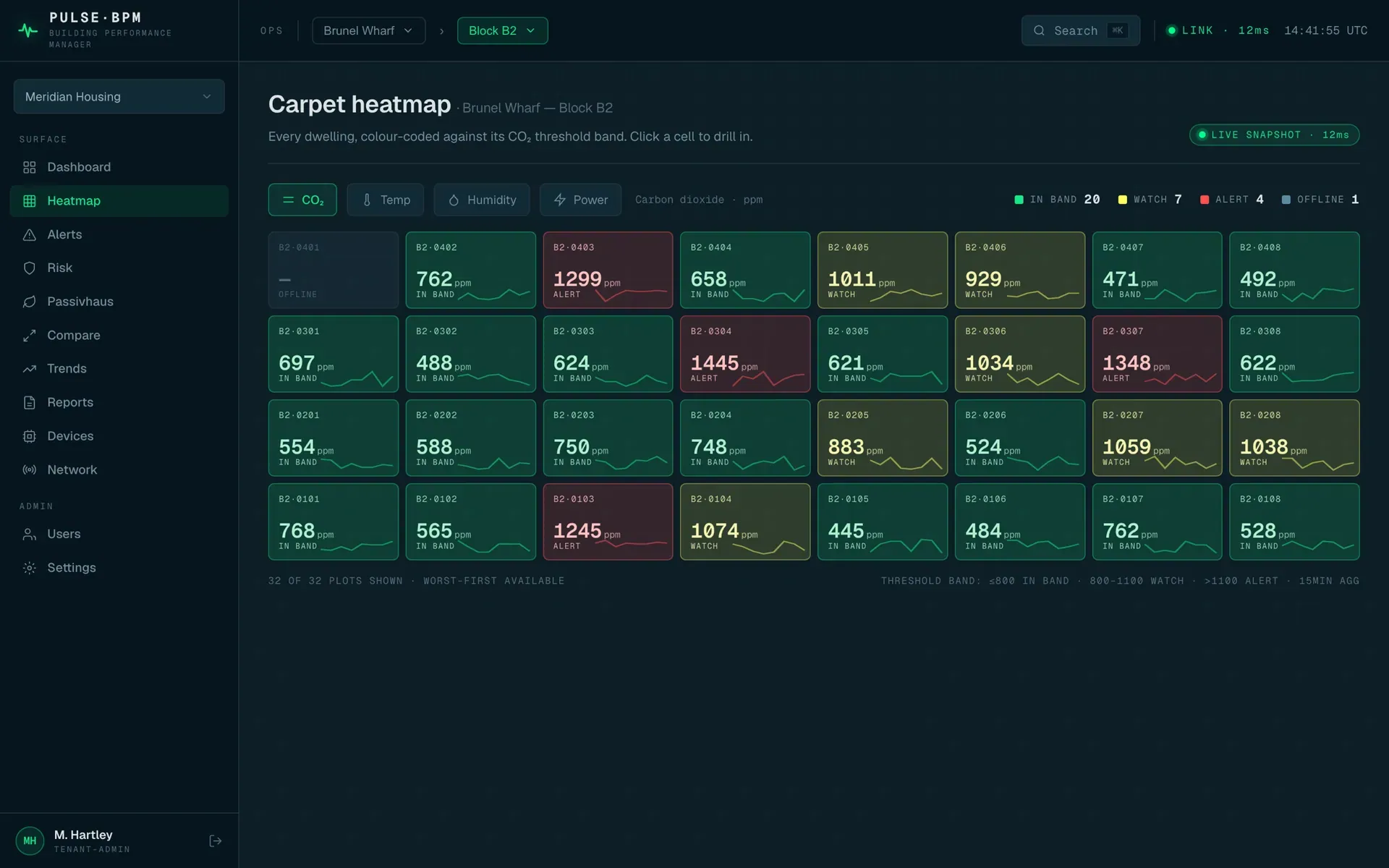
Every plot, colour-coded against its band.
Green is in band, amber is on watch, red needs action, grey is offline. One screen for a whole estate, and a click takes you straight into the cell that is drifting.
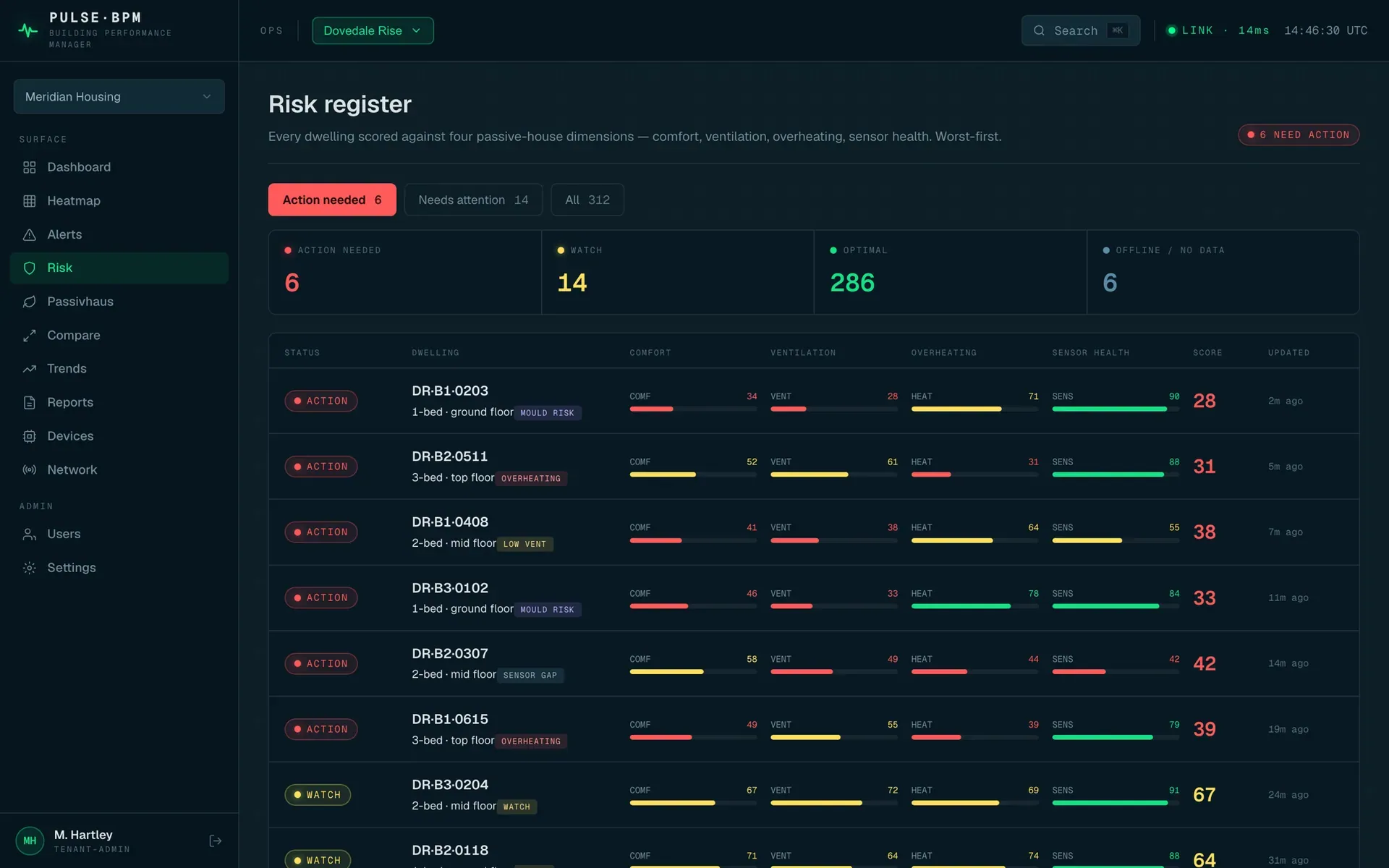
The worst dwelling, surfaced first, before a tenant has to complain.
Every dwelling scored against comfort, ventilation, overheating and sensor health, ranked worst-first. The facilities manager’s Monday-morning to-do list, generated automatically and timestamped for evidence.
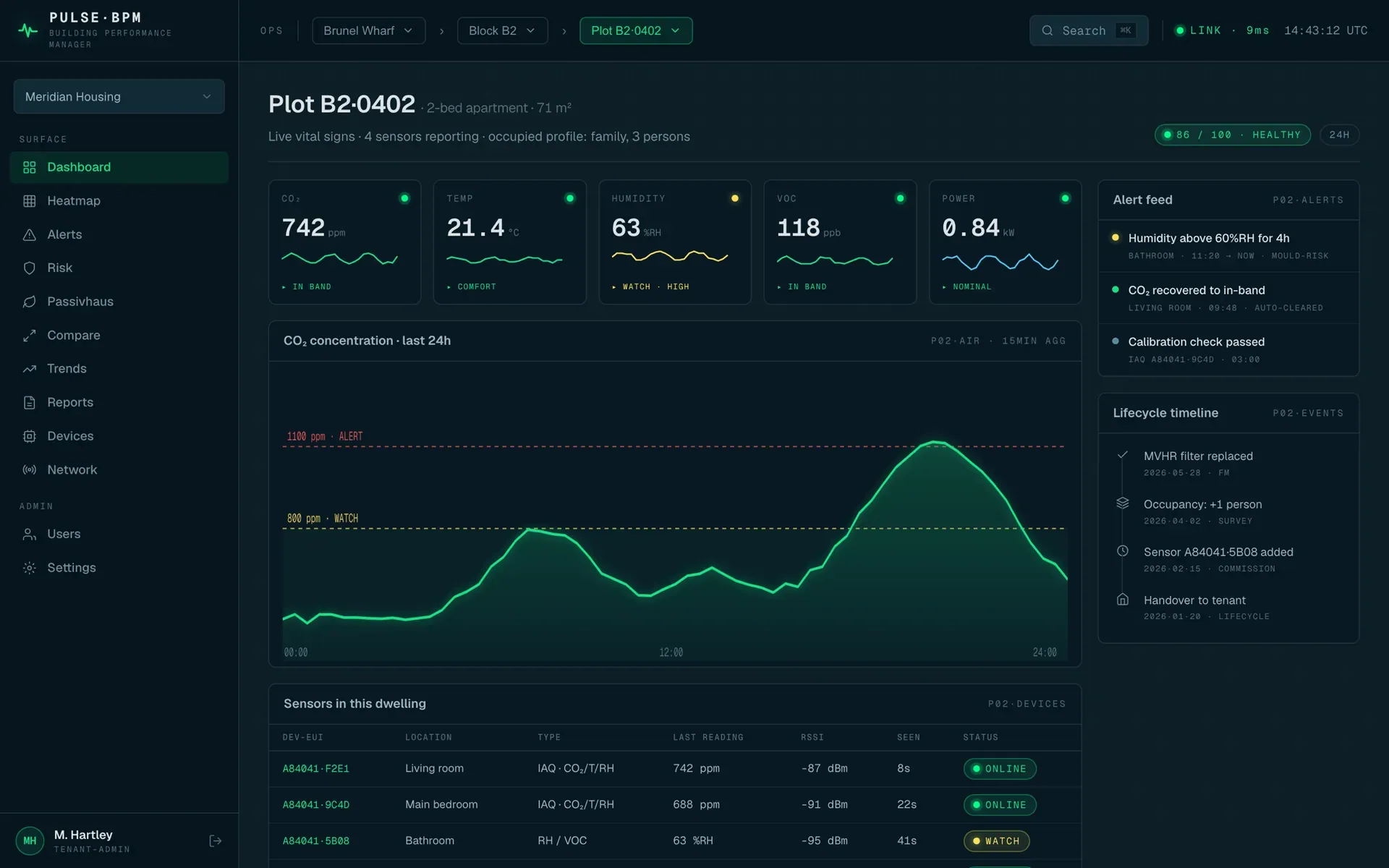
Three clicks from the whole portfolio to one bedroom’s CO₂.
Portfolio, scheme, block, dwelling, room. Drill-down is the whole interaction model: start where the colour is amber and land on the exact dwelling, with its live comfort, air quality and energy in one place. Overlay up to four measurements at any level, from the last hour to 180 days.
Every surface reads from the same numbers.
Threshold breaches & alerts
A live snapshot of every plot currently outside its comfort band, switchable by metric. "Overheating yesterday" is a query you can actually answer.
Passivhaus compliance
Overheating hours against the CIBSE tests (TM52/TM59), annual heating demand, primary energy, the airtightness test result and fabric heat-loss, per building, measured against the design target.
Reports & export
Board-ready compliance reporting and full raw-data export for the scientists. The numbers on the report are the same numbers on the dashboard.
Sensor health, LoRaWAN-first
Sensor-agnostic over LoRaWAN, no new cabling. A control-room register tracks every sensor and gateway, so you know a sensor went dark before the data gap becomes a compliance gap.
Each audience gets the same engine with different defaults.
Pulse, answered.
What is post-occupancy monitoring, and why does it matter?
Post-occupancy monitoring measures how a building actually performs once people are living in it, rather than how it was predicted to perform at design stage. It matters because the two routinely diverge: the performance gap between a design model and an occupied building is where comfort complaints, overheating, damp and unexpected energy bills live. Pulse closes that gap by measuring energy, temperature, CO2, humidity and air quality continuously, so problems surface as maintenance tasks rather than complaints.
Does Pulse only work with Passivhaus buildings?
No. Pulse is sensor-agnostic and works on any building, from a single home to a portfolio of thousands, new build or retrofit, Passivhaus or not. It is especially valuable on certified low-energy buildings because it proves the certified performance was kept, but the monitoring, alerting and compliance reporting apply to any stock an owner wants to understand and manage.
How does Pulse help with Awaab’s Law and damp and mould?
Awaab’s Law puts social landlords on a statutory clock to investigate and fix damp and mould. Pulse continuously scores every dwelling for mould risk, ventilation and overheating and surfaces the worst first, before a tenant has to complain, with every reading timestamped for evidence. That turns a reactive legal duty into a managed, evidenced process.
What does Pulse measure, and how is the data trustworthy?
Temperature, CO2, humidity, energy and water, aggregated from portfolio down to a single room. Every reading carries its conversion path and a quality flag and is converted once at write time, with no silent fallbacks, so the number on a board report is the same number on the dashboard. Where a value is provisional, the platform says so, and a control-room register flags any sensor that has gone quiet.
Can Pulse support London Plan "Be Seen" reporting?
Yes. The London Plan requires major developments to report metered energy performance to the GLA for five years after occupation through the Be Seen platform. Because Pulse is already measuring energy continuously with full provenance, the Be Seen submission becomes a by-product of monitoring the building is already doing, rather than a separate annual exercise.
See whether your buildings are actually performing.
A live walkthrough of a real portfolio, from the estate down to a single bedroom.