A certified low-energy envelope is a commercial asset.
Passivhaus for offices and mixed-use buildings.
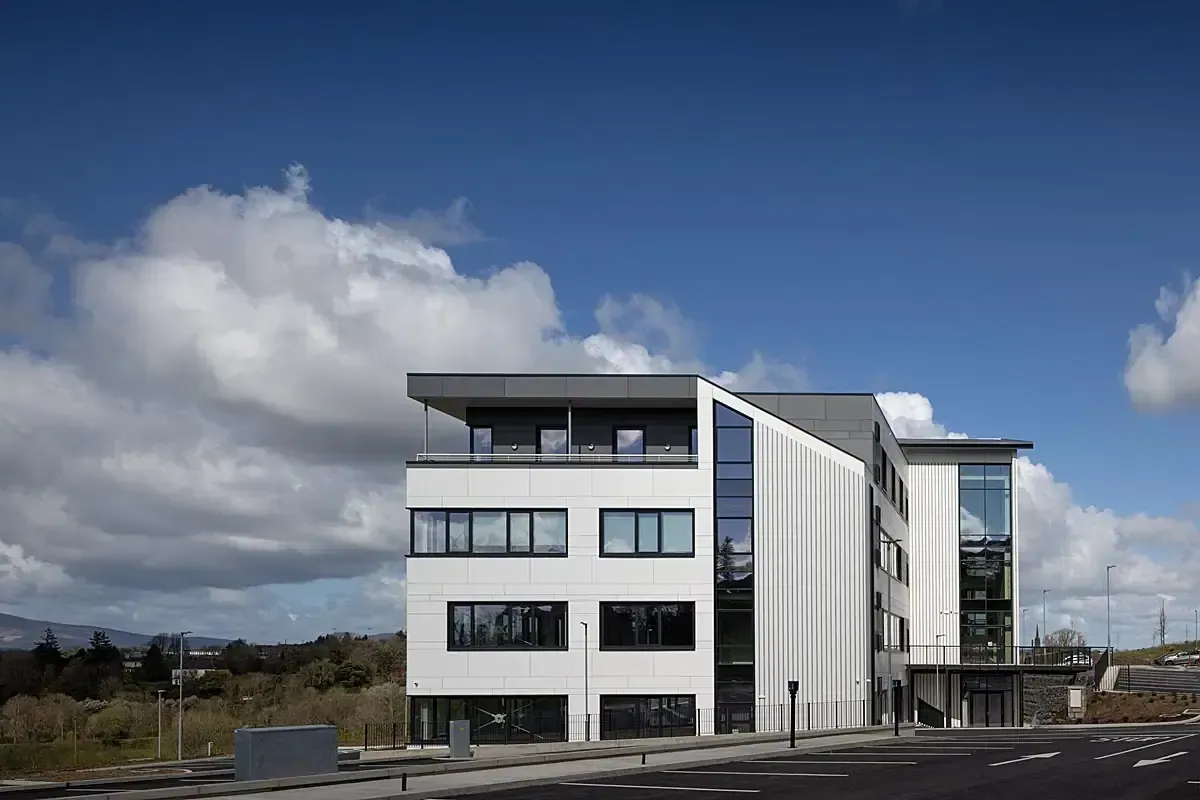
Commercial is where stranded-asset risk is highest and the ESG evidence gap is most exposed. Buildings that cleared the 2015 EPC threshold are already approaching the 2028 minimum. Corporate tenants with net-zero commitments will not sign leases on buildings whose operational carbon they cannot control. Investors under SFDR and green bond covenants need verified performance, not design-stage targets. Passivhaus closes all three gaps at once. Senan House in Enniscorthy, Ireland’s first certified Passivhaus office, won Ireland’s Most Sustainable Project in 2024, and it shows what the standard does in commercial practice.
Senan House, Enniscorthy
Ireland’s first certified Passivhaus office building. Designed and certified by Mosart for Wexford County Council’s Enniscorthy Technological Park, Senan House was named the most sustainable project in Ireland in 2024. It demonstrates that Passivhaus certification in the commercial sector is achievable on public budgets and within standard Irish procurement frameworks.
View case study → Why Passivhaus for commercial buildings.
The argumentA certified low-energy envelope is a leasing advantage
Occupiers increasingly specify minimum EPC ratings and ESG credentials as conditions of lease. Corporate tenants with net-zero commitments cannot sign leases on buildings that will require scope 1 and 2 emissions they cannot reduce. A Passivhaus-certified building addresses that constraint at the source. The envelope performs as tested, the heating demand is as certified, and the occupier's operational carbon can be modelled with confidence. As EPC thresholds tighten, the commercial buildings that will retain their lettable value are the ones whose performance was certified, not the ones that cleared the current threshold at design stage.
ESG disclosure needs verified performance
The gap between modelled and as-built performance is well documented. NABERS, GRESB and the EU Taxonomy increasingly require evidence of actual performance rather than design intent. Passivhaus certification is based on verified as-built data: blower door test results, PHPP calibration against actual measured performance, and a certified evidence pack that can be cited in ESG disclosures. For investors and asset managers subject to SFDR, green bond covenants or corporate net-zero targets, a Passivhaus-certified building provides the verified evidence base that a design-stage sustainability rating cannot.
Lower operating cost and resilience to energy price volatility
Commercial buildings carry significant energy cost in their service charges, plant operating costs and heating and cooling bills. A Passivhaus building with a certified maximum space heating demand of 15 kWh per square metre per year is fundamentally less exposed to energy price volatility than a standard building. The saving compounds over a long holding period and is particularly significant for owner-occupiers and those with long-term lease commitments where the operator carries the energy cost. At Senan House in Enniscorthy, Ireland's first certified Passivhaus office, the combination of high-performance fabric, airtightness and MVHR delivers running costs well below equivalent standard office stock.
Occupant comfort and productivity, year-round
Commercial offices lose occupants to lease breaks and failure to renew when the building environment is poor. Passivhaus removes the thermal comfort problems that most frequently drive complaints in standard commercial buildings: cold draughts near single-glazed curtain walls in winter, severe overheating on south and west facades in summer, noise from HVAC systems compensating for a poor envelope, and poor air quality from recirculated or inadequately diluted air. An office that stays comfortable through the year, whatever the floor or orientation, is an office that retains its tenants.
Future-proofing against tightening regulation
The regulatory direction in Ireland and the UK is clear: EPC minimum standards will rise, and the carbon and disclosure obligations on owners and investors with them. A building that just cleared the 2023 threshold is already behind the 2030 one. A Passivhaus-certified building stays ahead of it, exceeding the current nZEB standard and the projected targets for new commercial buildings across the decade. For developers and investors with long holding periods, that head start is a large part of the case for the standard.
Green premium on rent and capital value
Evidence from multiple European and UK commercial markets documents a green premium for certified low-energy commercial buildings over standard stock, in terms of both rent achieved and capital value. The premium is larger for buildings with verified third-party certification than for those with only design-stage ratings, and it has grown as the proportion of institutional investors with ESG mandates has increased. A Passivhaus-certified commercial building commands a premium that is defensible in a valuation and citable in a disposal data room.
Certification that holds up to scrutiny.
Senan House
Commercial and mixed-use projects.
03 / All projects
The envelope modelled before the facade is drawn.
Commercial buildings fail on energy performance when the facade specification is driven by aesthetics and cost, and the energy model is run as a late check against an already-fixed design. We do it the other way round: PHPP is live from feasibility, glazing ratios and solar shading are tested before the facade design is committed, and the thermal bridge calculation covers the curtain wall nodes before the specification goes to tender.
On mixed-use buildings, the PHPP model accounts for each use type separately, with its own occupancy pattern, ventilation load and internal gains. The certification covers the building as a whole, with each use type meeting the standard independently.
Common questions.
FAQDoes Passivhaus certification support EPC and MEES compliance for commercial buildings?
Yes. A building certified to Passivhaus will achieve a high EPC rating, comfortably meeting the current Minimum Energy Efficiency Standards and future-proofed against tightening thresholds. In England and Wales the government has signalled a trajectory toward EPC B for commercial lettings. A Passivhaus-certified building will meet this without requiring expensive fabric upgrades at the point of reletting, avoiding the stranded asset risk that threatens a large proportion of the existing commercial stock. In Ireland, BER A ratings are achievable for Passivhaus commercial buildings, supporting compliance with the Energy Performance of Buildings Directive requirements.
Can Passivhaus certification be used in ESG reporting and green financing?
Yes, and it is increasingly being required. Passivhaus certification is a third-party verified, internationally recognised performance credential from the Passivhaus Institute, which is accepted as evidence in GRESB submissions, EU Taxonomy eligibility assessments, SFDR disclosures and green bond frameworks. Unlike design-stage sustainability ratings, Passivhaus certification is based on verified as-built performance, which is the standard of evidence that credible ESG reporting increasingly demands. Investors and lenders applying green financing covenants are increasingly specifying certified performance standards rather than modelled targets.
Does Passivhaus cost more than standard commercial construction?
The construction cost premium for Passivhaus over standard commercial new-build is typically in the range of 4 to 8 percent, depending on the building type, procurement route and contractor experience. This premium is recovered through lower operating cost, lower maintenance obligations and, on well-specified buildings, a green premium on rent and capital value. For commercial buildings where the operating cost is carried by occupiers through service charges or directly by the owner, the running cost saving is material to the investment return from the first year of occupation. The risk of not building to a certified standard, in the form of stranded asset risk as MEES and EPC requirements tighten, is a growing liability that the capital cost premium insures against.
How does Passivhaus affect occupant comfort and productivity in a commercial office?
Commercial office occupants are sensitive to thermal comfort and air quality in ways that affect their productivity and their employer’s decision to renew a lease. Passivhaus offices maintain consistent temperatures without the cold draughts near windows or the overheating near south-facing glazing that characterise standard commercial buildings. MVHR ventilation keeps CO2 levels low and delivers filtered fresh air regardless of season, which reduces the respiratory illness and fatigue associated with recirculated or poorly diluted air in standard HVAC systems. Post-occupancy surveys of Passivhaus offices consistently show higher occupant satisfaction scores than standard buildings of equivalent specification.
Is Passivhaus certification achievable on mixed-use buildings with retail, residential and office uses?
Yes. Passivhaus can be applied to mixed-use buildings, with the PHPP model accounting for the different internal conditions, occupancy patterns and ventilation requirements of each use. The certification covers the whole building, and the PHI has developed specific guidance for mixed-use applications. The main engineering consideration is the separation of the thermal envelope and ventilation zones between different use types, which is addressed in the building physics strategy from the early design stages. Mosart has experience with mixed-use configurations in both residential-led and commercial-led schemes.
Talk to us about your commercial scheme.
Tell us the building type, GIA, occupancy and programme. We will tell you what Passivhaus requires, what the ESG evidence pack looks like, and what the lifecycle cost argument is.