Usually yes, but not automatically. The honest version: a passive house costs more to build, somewhere between 4% and 9% extra on construction on current UK evidence, and pays it back through heating bills, comfort and certainty. Whether the trade works for your project depends on energy prices, procurement and how long you hold the building.
That answer deserves to be unpacked, because the marketing around low-energy building is full of round numbers nobody can stand over. Here is what the published evidence actually supports.
What does it cost extra to build?
The best dataset is the Passivhaus Trust’s Passivhaus Construction Costs study, which compared completed UK Passivhaus schemes against conventional baselines. Its 2015 research put the extra-over cost at 15% to 20%. By 2018, best practice had fallen to about 9%, and Exeter City Council, with nearly nine years of repeat experience, was building at roughly 8% over baseline. The study’s projection for Passivhaus adopted at scale is around 4%.
A separate analysis by Currie and Brown for the UK Committee on Climate Change, cited in the same report, estimated the at-volume extra cost of building to a 15 kWh/m²a fabric standard at £4,800 for an 84 m² semi, about £57 per square metre, or 4.3% of build cost.
No equivalent Irish dataset has been published, but the direction matches what we see in Irish tenders: the premium is real, it is single-digit when the team knows what it is doing, and it balloons only when Passivhaus is bolted on late.
What do you get back in running costs?
Ireland is an expensive place to waste energy. Eurostat’s electricity price statistics put Irish household electricity at €0.4042 per kWh in the second half of 2025, the highest in the EU and well above the EU average of €0.2896.
Now run the passive house number against that. The standard caps space heating at 15 kWh/m²a, so a 100 m² home needs about 1,500 kWh of heat a year. Even delivered through a plain electric radiator at full Irish prices, that is around €600 a year. With a heat pump it falls to a fraction of that figure. An older, leaky home of the same size needs several times the energy to stay barely comfortable, and every future price rise widens the gap. High energy prices are miserable, but they make fabric efficiency the most reliable hedge available.
The precise payback year depends on tariffs, fuel and behaviour, and we resist publishing one for that reason. The durable point is simpler: the cheapest kilowatt-hour is the one the fabric never asks for, and a certified building locks that in for its whole life, whatever prices do next.
Is the comfort and health benefit real?
This is where the evidence is more interesting than the bills. The Passivhaus Trust’s research found the average UK home consumes at least 40% more energy than its design predicts, with conventional buildings showing space heating overruns around 60%, while certified passive houses are reliably found to perform as designed. Certification is the difference: the model is checked, the airtightness is measured, and internal surface temperatures and condensation risk are verified before the certificate issues. That last check is quietly significant in an era of damp-and-mould litigation, because mould needs cold surfaces to grow on.
Landlord experience backs this up. The same costs study records why local authorities keep returning to the standard: lower voids, lower arrears, fewer defects. Exeter City Living’s managing director put it plainly: their oldest Passivhaus dwellings were almost ten years old and had not needed a single component replaced.
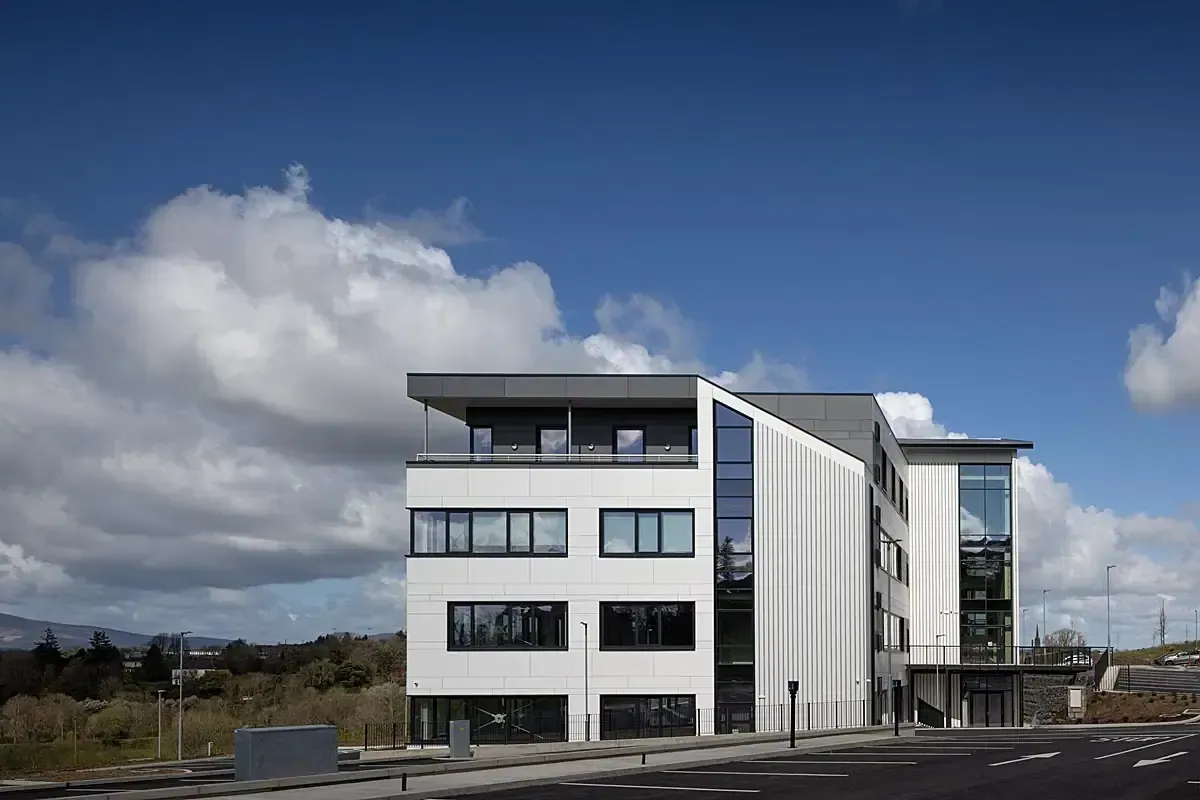
We hear the same thing from occupants of Senan House in Enniscorthy, the first certified Passivhaus office building in Ireland: even temperatures and a quietness that surprises people who have only worked in conventional buildings.
What does the evidence actually support?
An honest scorecard, benefit by benefit.
| Claimed benefit | What it rests on | Strength |
|---|---|---|
| Low heating bills | Certified demand caps plus measured Irish energy prices | Strong |
| Performs as modelled | UK monitoring vs 40–60% overruns in conventional stock | Strong |
| Comfort, air quality, quiet | Certification criteria plus consistent occupant and landlord reports | Good, partly qualitative |
| Lower maintenance and voids | Landlord experience, notably Exeter’s decade of data | Emerging |
| Resale premium | Little published Irish data to date | Weakest; treat as upside, not basis |
We deliberately keep the resale row honest. Certification is increasingly written into funding conditions and procurement briefs, which supports value, but anyone quoting a precise resale uplift for the Irish market is guessing. What we can stand over is behaviour: certified schemes clear funder due diligence faster, because the certificate replaces argument with evidence. Buyers may not yet pay a measured premium, but lenders and public clients already treat certification as de-risking.
When is it not worth it?
Four situations where we advise clients to pause:
- Passivhaus arrives late. If the design is fixed and planning is granted, retrofitting the standard onto the scheme means redesign fees and bolt-on measures. The cost studies are clear that the low premiums belong to projects where Passivhaus was in the brief from day one.
- A complex bespoke form on a tight budget. Setbacks, cantilevers and large glazed walls each carry an envelope penalty. A self-builder in love with a complicated form should price that honesty early, ideally through a feasibility study.
- A team that will not engage. The standard is delivered by sequencing and site discipline. A contractor who treats the airtightness layer as someone else’s problem will burn the budget.
- Pure short-hold capital plays. If the only metric is lowest capital cost and immediate disposal, the running-cost benefit accrues to someone else. Even then, certification can be what gets the scheme through a funder’s door.
Where Mosart fits
The worth-it question is ultimately a numbers question for your own site and budget, which is what our feasibility studies answer before you commit. After 500+ certified units, we can usually tell you quickly which side of the line a project sits on. Compare yours against real certified schemes on our benchmark, or talk to us about the brief.