NZEB is a regulatory minimum: every new building in Ireland must meet it, and compliance is demonstrated by calculation under Part L using DEAP. Passive House is a voluntary performance standard: it sets stricter fabric and airtightness targets and verifies them through on-site testing and independent certification. A Passivhaus generally exceeds NZEB; the reverse is not true.
The two are often spoken about as if they were rival labels for the same thing. They are not. One is a legal floor, the other is a verified performance standard, and the difference shows up most clearly in how each one is proven.
What is NZEB?
NZEB, the nearly zero energy building requirement, is the energy performance level that Irish building regulations demand of new buildings under Part L. It sets limits on calculated primary energy and carbon, supported by backstop values for individual elements, such as the wall U-value backstop of 0.18 W/m²K. Compliance is demonstrated in DEAP, the national calculation methodology.
Two features define it. First, it is mandatory: NZEB is simply what the law requires, not a distinction a project earns. Second, it is calculated: the building complies on paper, using the conventions and standardised assumptions of the compliance methodology. There is no requirement for an independent third party to review the design, and the gap between the calculated rating and the building’s real behaviour is not part of the compliance question.
What is Passive House?
Passive House, or Passivhaus, is a voluntary international standard administered by the Passive House Institute. Its Classic criteria are fixed and few: space-heating demand of 15 kWh/m²a or less (or a heating load of 10 W/m² or less), airtightness of 0.6 air changes per hour at 50 Pa, primary energy renewable demand of 60 kWh/m²a or less, and overheating limited to 10% of hours above 25°C. The design is modelled in PHPP, the standard’s energy model, and the headline targets are backed by element-level expectations such as opaque U-values around 0.15 W/m²K and installed window values of 0.80 W/m²K or better.
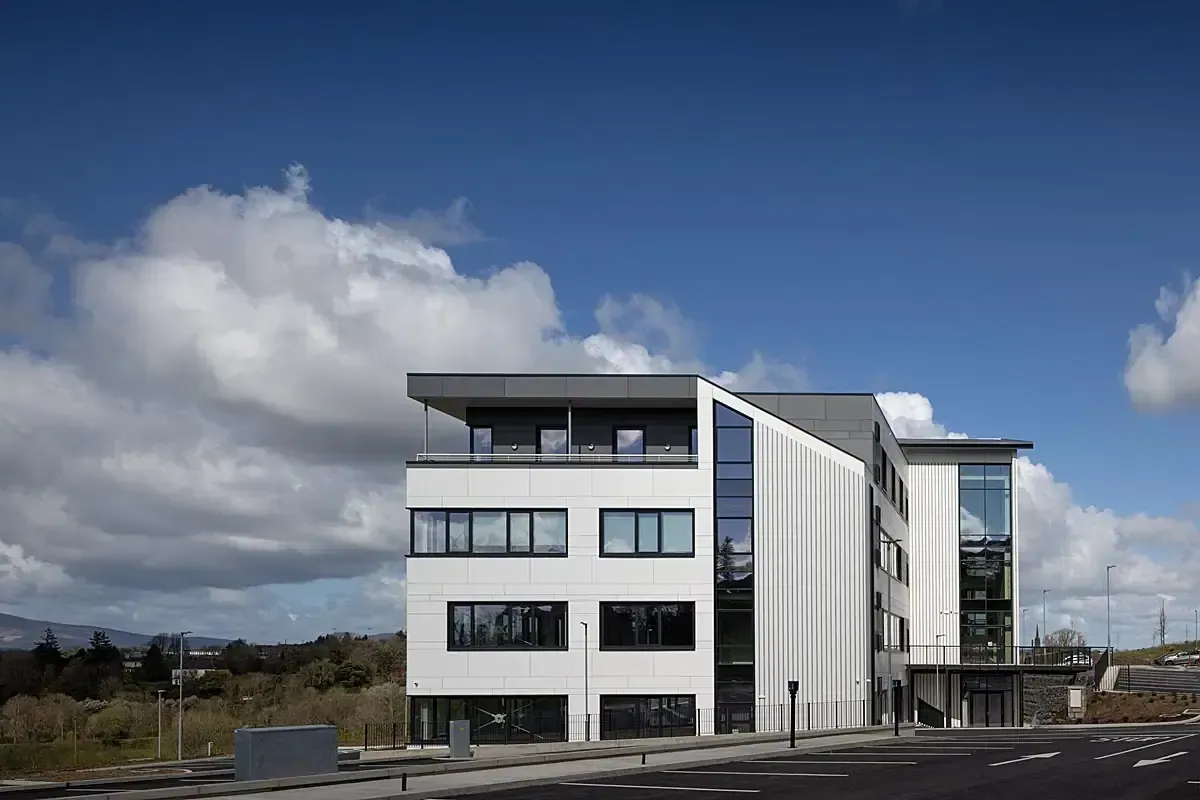
The defining feature is verification. The airtightness figure is not a design assumption; it is measured on the finished building with a blower-door test to EN ISO 9972. The whole package, design model, construction evidence and test results, is then reviewed by an independent accredited certifier before the Passive House Institute issues a certificate. Senan House in Enniscorthy, Ireland’s first certified Passivhaus office, holds its certificate because the built reality was tested and independently checked, not because a calculation said it should work.
How do the standards compare?
| NZEB (Part L) | Passive House (Classic) | |
|---|---|---|
| Status | Mandatory regulatory minimum | Voluntary certified standard |
| Heating demand | No explicit space-heating demand target; overall primary energy and carbon limits | ≤15 kWh/m²a (or heating load ≤10 W/m²) |
| Airtightness | Regulatory backstop, assumed or tested for the calculation | ≤0.6 ACH at 50 Pa, measured by blower-door test to EN ISO 9972 |
| Verification | Calculated compliance in DEAP | PHPP model plus site evidence, reviewed by an independent certifier, certificate from PHI |
| Comfort | No equivalent comfort criteria | Overheating ≤10% of hours above 25°C; fabric and ventilation criteria sized for comfort |
The airtightness row is the sharpest illustration of the philosophical gap. The Passivhaus limit of 0.6 ACH is many times more demanding than typical regulatory backstops, and, more importantly, it is a measured result. A building either achieves it under test or it does not.
Does an NZEB building perform like a Passivhaus?
Not as a rule. NZEB is calculated for compliance, and the methodology’s standardised assumptions mean the rating describes a notional version of the building rather than the one that gets handed over. Nothing in the compliance process tests whether the insulation was fitted as drawn, whether the junctions perform as assumed, or whether the envelope is anywhere near as airtight as the calculation supposed.
Passivhaus closes that gap deliberately. The combination of PHPP modelling, calculated thermal bridges, certified component data, on-site pressure testing and independent as-built review means the certificate describes the building as built. That is why the standard is trusted as a proxy for real in-use performance in a way that a compliance rating cannot be.
Put plainly: a Passivhaus building will generally sail past the NZEB requirement, because its fabric and systems sit well beyond the regulatory minimum. An NZEB-compliant building, by contrast, may be nowhere near Passivhaus performance, and there is no test in the compliance route that would reveal it.
Which should a client ask for?
NZEB is not a choice; every new building must meet it. The real question is whether to stop there. For clients who care about running costs, comfort and the risk that a building underdelivers against its rating, the case for going beyond the minimum rests on verification. A useful way to frame the decision:
- If the requirement is simply a compliant building, Part L and DEAP define the scope, and NZEB is the answer by default.
- If the requirement is a building that demonstrably performs, the project needs measured airtightness, modelled and calculated fabric, and independent review, which is what Passivhaus certification provides.
- If the requirement sits in between, the Passivhaus design disciplines, starting with fabric basics you can test in our U-value calculator, still raise the floor of what compliance alone delivers.
For many building types the cost difference between a thoughtful NZEB design and a Passivhaus is a matter of design discipline applied early, not a different class of construction.
Where Mosart fits
Mosart works on both sides of this line, from Passivhaus, ZEB and NZEB architecture to independent Passivhaus certification. If you are weighing the two standards on a live project, start with the fabric: our U-value calculator shows quickly where a compliant build-up stands against a Passivhaus one.