A passive house is a building designed, built and tested to need almost no heating: 15 kWh per square metre per year or less, a fraction of what a typical older Irish home burns. It is not a look, a product or a brand. It is a measurable performance standard, verified by independent certification.
The standard is maintained by the Passive House Institute in Darmstadt and works for any building type: houses, apartment blocks, offices, schools, student accommodation. The physics does not care about the architecture, which is why certified buildings range from cottages to high-rise towers and look nothing alike.
What does the standard actually require?
Four numbers, each backed by evidence rather than promises.
| Criterion | Passive House (Classic) requirement |
|---|---|
| Space heating demand | No more than 15 kWh/m² per year |
| Airtightness | No more than 0.6 air changes per hour at 50 Pa, tested on site to EN ISO 9972 |
| Primary energy renewable (PER) | No more than 60 kWh/m² per year |
| Overheating | No more than 10% of hours above 25°C |
The airtightness number is the one that separates intention from delivery, because it cannot be modelled into existence. A blower-door test either passes or it does not. In the PHPP files we review as certifiers, the heating demand target is usually the manageable part. The airtightness result is where projects are won or lost on site.
For existing buildings there is a sister standard, EnerPHit, with a relaxed heating target of 25 kWh/m²a (or a component-quality route) and an airtightness limit of 1.0 air changes per hour, because nobody can redesign a foundation that is already in the ground.
What are the five principles?
The Passive House Institute lists them as very good thermal insulation, highly energy-efficient windows, controlled mechanical ventilation with heat recovery, no thermal bridges, and airtightness. Here is what each means in practice:
- Insulation. Walls, roof and floor typically need U-values around 0.15 W/m²K in the Irish and UK climate. Nothing exotic. The skill is keeping the layer continuous, with no gaps where trades meet.
- High-performance windows. An installed whole-window U-value of 0.80 W/m²K or better, which here means triple glazing in insulated frames. The word installed matters: a good window fitted badly fails the standard.
- Airtightness. A deliberate, continuous air barrier drawn on the sections before anyone prices the job. On site this shows up as taped boards, membranes and service grommets that must be finished before the plasterers and electricians arrive.
- Ventilation with heat recovery. An MVHR unit running quietly all the time, recovering at least 75% of the heat in outgoing stale air while supplying filtered fresh air to every habitable room.
- Thermal-bridge-free design. Junctions detailed so heat has no shortcut through the envelope. This is design work, not product selection, and it is where most of the engineering judgement sits.
None of the five is novel on its own. The standard is the discipline of doing all of them at once, then proving it with a test and a paper trail.
Where did the standard come from?
The concept grew out of a research cooperation started in 1988 between the German physicist Wolfgang Feist and the Swedish academic Bo Adamson. The first passive house, a terrace of four dwellings, was completed at Darmstadt-Kranichstein in 1991. According to the Passive House Institute’s training materials, those original dwellings were monitored in detail and “met the predictions of the building simulation exactly, even after 24 years”.
That long monitoring record is the standard’s quiet strength. It is not a theory awaiting confirmation; it is three decades of measured buildings behaving as their models said they would. Mosart was founded in 1993, two years after Kranichstein, and has worked with the standard for most of its existence, including authoring Ireland’s national Passive House guidelines. Within one working lifetime, passive house has gone from a research terrace in Germany to a procurement requirement on Irish public housing schemes.
Can you open the windows?
Yes. This is the most persistent myth, so it is worth being blunt. Airtight does not mean unventilated. The airtightness layer stops uncontrolled leakage through cracks and junctions; the MVHR provides controlled, filtered fresh air around the clock. Every window still opens, and on summer evenings opening them is exactly what the design assumes you will do.
The irony is that the sealed-box accusation has it backwards. A leaky house ventilates at random: too much on a windy January night, almost nothing on a still day. A passive house delivers fresh air constantly, which is why occupants tend to report less stuffiness, not more.
A second myth says a passive house has no heating at all. In the Irish climate, most certified buildings keep a small heat source for the coldest weeks. The point is that the demand is so low the system can be tiny, and the bill with it.
Does it work outside the brochure?
This is the right sceptical question, and the evidence is unusually good. The Passivhaus Trust points out that conventional UK buildings have shown around a 60% increase in space heating demand compared with what their designs predicted, the well-documented performance gap. Certified passive houses, by contrast, are reliably found to perform as designed on average. The certification process is the reason: every claim in the energy model is checked against drawings, site evidence and a measured airtightness result before a certificate is issued.
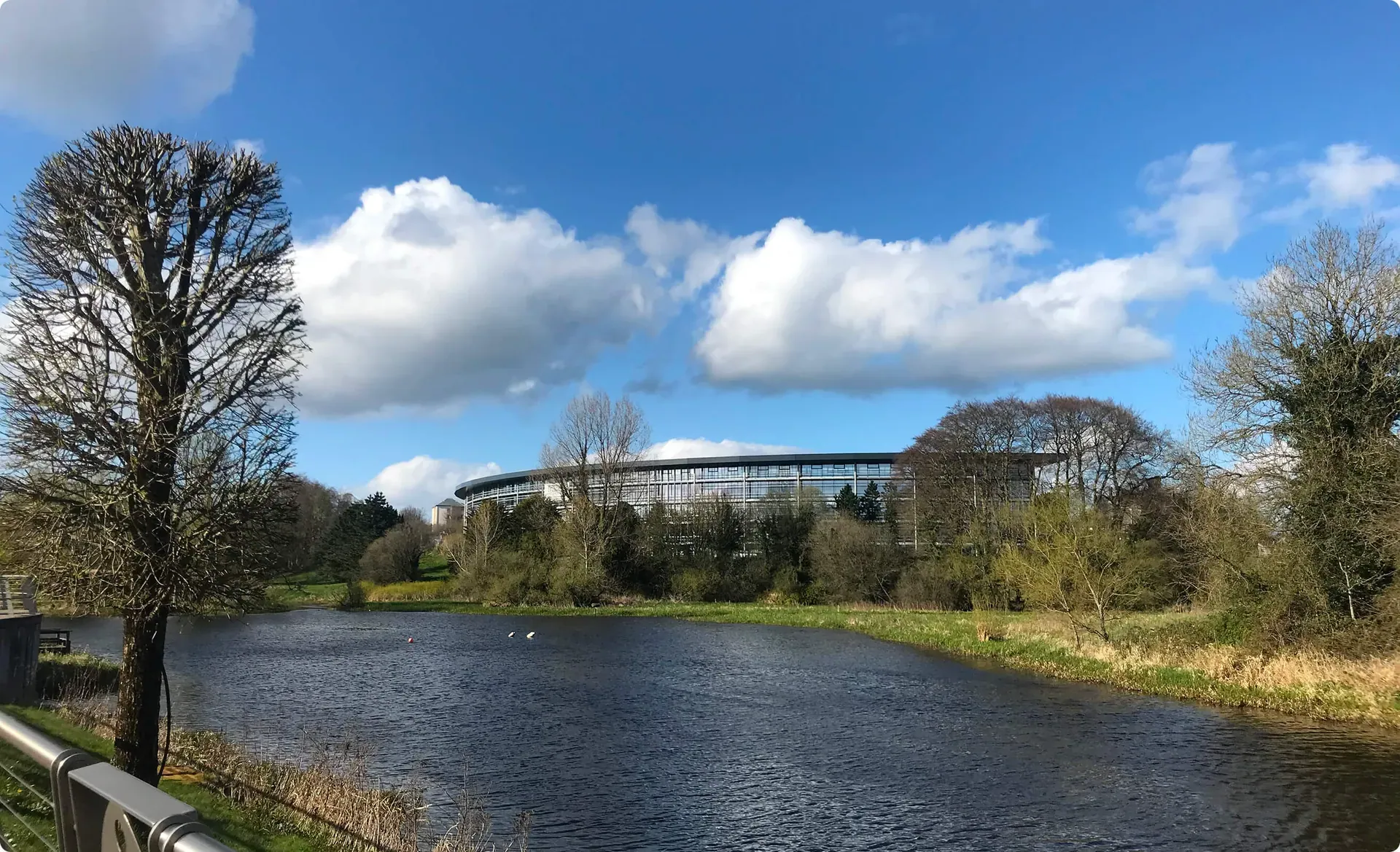
We see it at every scale. Erne Campus in Enniskillen, which Mosart designed and certified, is a full third-level campus building delivered to the standard, with the same blower-door discipline as a single dwelling, just with more junctions to check.
Where Mosart fits
A standard that lives on verification is only as good as its certifiers, and that is the part Mosart does most: ours is the largest independent team of PHI-accredited certifiers in Ireland. If you have a project in mind, our Passivhaus certification service covers design-stage review through to the PHI certificate. To learn the standard properly, start with the Certified Passivhaus Designer course.