Start from the ordinary number. The SCSI puts the all-in cost of delivering a new three-bed semi in Ireland at €397,000 on average, before anyone mentions energy standards. Building that home to passive house adds single-digit percentages to construction cost on the best available evidence, and the figure falls with scale and repetition.
Anyone who quotes you a single euro-per-square-metre rate for “a passive house in Ireland” is selling something. What can be pinned down are the Irish baseline costs, the measured premium from UK research, and the levers that move it.
What does an ordinary new home cost in Ireland first?
Two SCSI datasets frame the baseline. The Real Cost of New Housing Delivery 2023 examined over 8,500 units across 80 sites and found the average cost of delivering a 114 m² three-bed semi in a private scheme ranged from €354,000 in the Northwest to €461,000 in the Greater Dublin Area, with a national average of €397,000. Only 53% of that is hard construction cost; the rest is land, levies, finance, VAT and fees. In Dublin the split tips to 49% hard, 51% soft.
For pure construction rates, the SCSI’s house rebuilding cost guide from November 2025 reports rebuild costs up 7% nationally in twelve months, with Dublin estate-type homes at €3,381 per square metre and the Northwest at €2,756. Those are insurance rebuild figures for standard estate housing, not one-off rural homes, but they show where Irish construction pricing sits and how fast it is moving.
Keep the two numbers in their lanes. The €397,000 measures everything it takes to deliver a home, land and VAT included. The per-square-metre rates measure construction alone. Passivhaus premiums attach to the construction slice, which is why quoting them against all-in delivery costs either flatters or frightens, depending on who is doing the selling.
How much does the passive house standard add?
The most rigorous published evidence is the Passivhaus Trust’s Passivhaus Construction Costs study, built on completed UK schemes. Its trajectory:
| Benchmark | Extra-over cost | Context |
|---|---|---|
| Early UK projects (2015 research) | 15–20% | Scattered one-offs, immature supply chain |
| Best practice (2018) | ~9%, about £115/m² | Simple forms, experienced teams |
| Exeter City Council | ~8% | Nearly nine years of repeat delivery |
| Projected at scale | ~4% | Steady-state adoption |
| Currie and Brown for the UK CCC | £57/m², about 4.3% | 15 kWh/m²a fabric standard at volume |
Translating to Ireland needs care, because the premium applies to construction cost, not the all-in delivery figure. Take the national-average semi: roughly €210,000 of its €397,000 delivery cost is hard construction. A 9% construction premium is about €19,000 on the whole house; at the mature 4% rate it is under €9,000. Set against a delivery cost approaching €400,000, the standard moves the total by 2% to 5%. The tenders we review in Ireland follow the same shape: single digits where Passivhaus was in the brief from the start, worse where it was bolted on after planning.
What actually drives the extra cost?
Five items do most of the damage, and one gives money back:
- Windows and external doors. Triple glazing in insulated frames, installed to hit 0.80 W/m²K as fitted. Cost rises steeply with glazing area, so a glassy design pays twice.
- Mechanical ventilation with heat recovery. Always required, always certified, always commissioned. Where MVHR was planned anyway, as it increasingly is, the uplift to Passivhaus spec is modest.
- Airtightness materials and sequencing. Tapes, membranes and parge coats are cheap; the labour discipline to reach 0.6 air changes per hour is the real line item, and it shrinks fast with crew experience.
- Design time, PHPP modelling and quality assurance. The energy model, junction calculations and site supervision that make the other money work. The UK research notes this QA spend is what closes the performance gap that conventional buildings simply leave open.
- Testing and certification. Blower-door tests, commissioning records and the certification fee itself, typically one of the smaller items on the list.
The offset: heating and hot water plant usually comes in cheaper than a conventional build, because a passive house needs a far smaller heat source and fewer emitters. The UK costs study records it as a net saving.
Where does the premium shrink?
Scale and repetition. Certifying and building one bespoke house means solving every junction once and using the solution once. A scheme built from a handful of repeated unit types spreads that effort across hundreds of homes, which is the economics behind Passivhaus at scale.
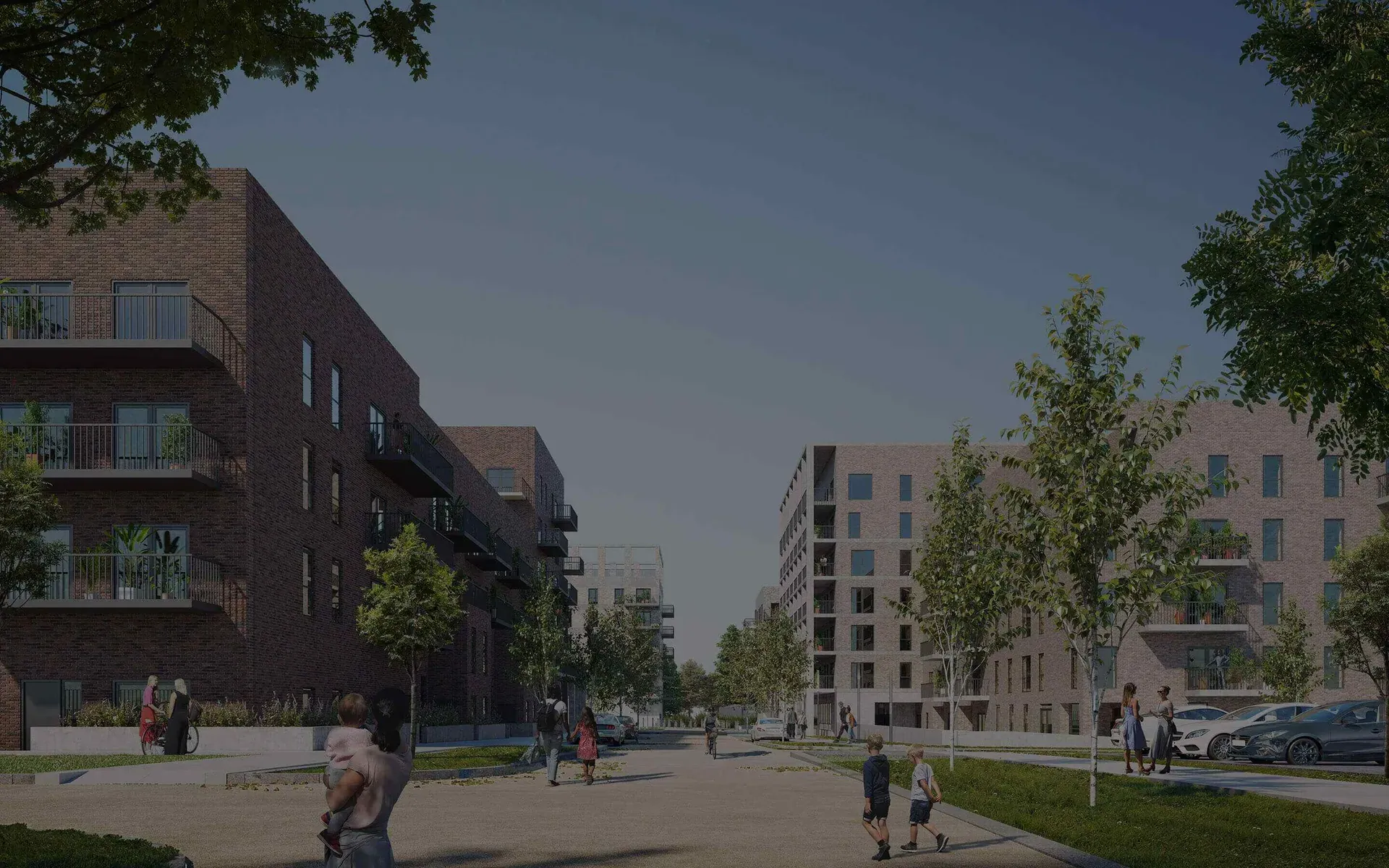
Ireland now has the proof on site. Shanganagh Castle in Dún Laoghaire is delivering over 550 Passivhaus social and affordable homes, and Seven Mills in Dublin is a 5,500-home new town with Mosart acting as certifier. On schemes like these, the per-unit cost of the standard behaves the way the UK projection says it should: the design effort amortises, the supply chain quotes keenly because volumes justify it, and site crews get fast at the airtightness details by the second block.
For a self-builder the lesson translates directly. Keep the form simple, commit to the standard before design freeze, and pick a team that has done it before. Those three decisions are worth more than any product substitution. On the schemes we certify, the cheapest airtightness strategy is always the one priced before tender; the dearest is the one improvised around the services mid-build.
How should you budget your own project?
Treat the premium as a range you can manage, not a fixed tax. Decide the standard early, test the design against it while changes are still free, and get real numbers rather than folklore. A short feasibility study at concept stage typically settles the question for a specific site and brief.
Where Mosart fits
The numbers above come from delivered schemes and published research, and yours should too. Begin with a feasibility study to price the standard for your brief, or talk to us about where your project sits.