Passive House certification runs in four moves: appoint an independent accredited certifier, submit the PHPP and design documents for a design-stage review, build and test, then submit as-built evidence for the final review. PHI issues the certificate. Appointed early, the whole sequence runs parallel to a normal programme and adds no time.
The detail below follows the procedure the Passive House Institute sets out in its Building Certification Guide, which is worth reading in full if you are the one assembling the evidence.
What are the steps from feasibility to certificate?
- Appoint the certifier at feasibility. The PHI’s guide recommends contacting the certifier “at an early stage of the planning”, because problems found now are corrections, not redesigns. The certifier will quote based on floor area, programme, project type and the team’s experience.
- Build the PHPP from concept. The energy model is the spine of the whole process. Every later review checks documents against it, so it needs to exist before the big decisions are made, not after.
- Initial check. The certifier flags anything unusual about the project and agrees how it will be assessed. On a standard house this is short. On a swimming pool or a campus building it is not.
- Design-stage review. Before construction starts, the full PHPP, the planning documents and the technical data for energy-relevant products go to the certifier. Expect 2 to 4 weeks. The certifier either confirms the design will meet the standard or lists the corrections needed. Construction should wait for that confirmation.
- Build, and gather evidence as you go. Photographs of the airtightness layer and insulation before they are covered, delivery records for substituted products, and an airtightness test while the envelope is still accessible. Anything closed in without a record is a question you cannot answer later.
- Test and commission. The final blower-door test to EN ISO 9972 must come in at 0.6 air changes per hour or better at 50 Pa. The ventilation system is commissioned and its flow rates balanced and documented.
- As-built review. The updated PHPP plus all construction evidence goes back to the certifier. Expect 4 to 8 weeks, longer if the documentation is patchy or the queries bounce.
- Certificate issue. PHI processing takes a further 4 to 8 weeks. The owner receives the certificate, a booklet documenting the building’s verified energy values, and an optional wall plaque. Each certificate carries an identification number issued by PHI for that specific building.
Who does the work, and who checks it?
Two distinct roles, deliberately kept apart. The Passivhaus designer or consultant sits inside the project team: building the PHPP, advising on details, assembling the submission. The certifier sits outside it, reviewing that work against the criteria.
The independence rule is strict. The PHI guide states that accredited certifiers “may not certify a building for which the Certifier has also performed project planning”, and the Passivhaus Trust makes the same point from the other side: a designer accreditation does not qualify anyone to certify, and the certifier cannot double as the project’s designer. A certificate is only credible because the person issuing it had no stake in the design decisions.
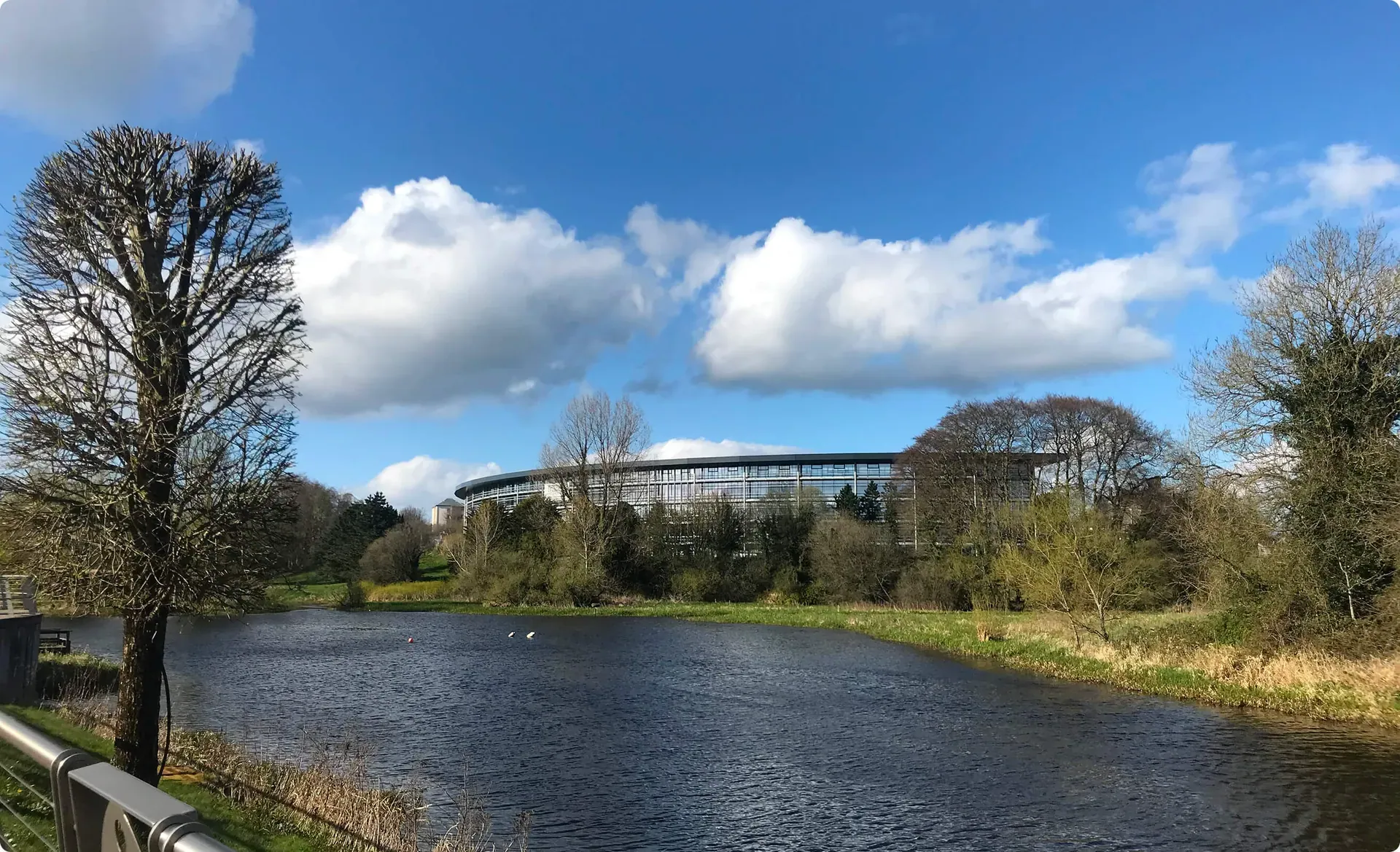
In practice the relationship is closer to a structured conversation than an exam. Mosart’s seven PHI-accredited certifiers, the largest independent team in Ireland, answer design queries throughout a project precisely so the formal reviews confirm decisions rather than contest them. On Erne Campus in Enniskillen, a PHI-certified building of real scale and complexity, that running dialogue is what kept certification off the critical path.
How long does each review take?
| Stage | Duration | When it happens |
|---|---|---|
| Design-stage review | 2 to 4 weeks | Once the full PHPP and design documents are submitted, before construction |
| As-built review | 4 to 8 weeks | After completion, testing and commissioning |
| PHI processing and certificate issue | 4 to 8 weeks | After the as-built review closes |
None of these stages needs to delay anything. The design-stage review runs while the contractor is procured. The as-built review runs during handover and snagging. The projects that feel certification as a delay are the ones that started it at practical completion, where every review lands on the critical path and every query stops the clock.
What documents does the certifier need?
The full list sits in the PHI criteria, but the core set is consistent: the complete PHPP; plans to scale in a readable format with the dimensions needed to verify treated floor area, envelope areas and junction lengths; technical data sheets for every energy-relevant product; the blower-door report; the ventilation commissioning and flow-rate balancing records; the construction manager’s declaration that the building matches the submitted drawings; and site photographs of the layers that are now hidden.
There is a pattern in that list. Every item is cheap to capture at the right moment, and somewhere between expensive and impossible to recreate afterwards.
What do certifiers actually reject?
Very rarely the building. Almost always the evidence. The recurring failures we see across the PHPP files we review are a treated floor area measured to a gross convention instead of PHI rules, which silently shifts every kWh/m²a result; psi-values asserted rather than calculated; an airtightness test run after finishes closed in the leaks; and products substituted during construction without anyone running the change back through the model.
None of these is fatal if caught at the design-stage review. All of them are painful at the as-built review. The fix is sequencing, not heroics: measure the treated floor area correctly on day one, calculate the junctions you cannot point to a certified detail for, and test airtightness while the membrane is still reachable.
Does the process scale?
Yes, and at scale it gets more efficient rather than less. At Seven Mills in Dublin, the 5,500-home new town Mosart is certifying with Cairn Homes, the unit types repeat, so a design-stage review finding on one type is a correction applied across hundreds of homes. The evidence-gathering becomes routine site practice rather than a special event. That is how certification works on Ireland’s largest schemes without slowing them.
Where Mosart fits
Mosart works the certifier’s side of this process, through our Passivhaus certification service, and offers separate PHPP modelling support for teams on the design side of the fence. Before you submit anything, sanity-check your area assumptions with the treated floor area tool. It is the first thing a certifier checks.