Form factor is the area of a building’s thermal envelope divided by its treated floor area. It tells you how much surface is losing heat for every square metre you actually heat. Two buildings with identical U-values can need very different insulation budgets purely because one is a compact box and the other sprawls.
What is the heat loss form factor?
Add up every surface through which the building loses heat: walls, roof, floor, all measured at the outside of the thermal envelope. Divide by the treated floor area, the heated, usable floor inside. The result usually lands between 0.5 and 5, and the Passivhaus Trust’s design guidance advises aiming for 3 or less, noting that while almost anything can be made to work, the better the ratio, the more economic the solution.
The physics is the same reason you hug your knees when you are cold: less surface, less loss. A building shaped like a sprawled body, all wings and projections, exposes far more envelope per square metre of accommodation than a simple two-storey rectangle holding the same floor area.
The relationship to specification is direct and unforgiving. As Greenspec’s analysis of the form factor puts it, heat loss area and required U-value scale linearly: double the envelope area around the same floor area and the insulation must work twice as hard to hold the same demand. The same source notes the happy extreme, a large compact apartment block with a form factor near 1.0 can meet Passivhaus with an average U-value of just 0.28 W/m²K, looser than the backstop wall value in the building regulations of the time. Compactness, not heroic insulation, is what made it possible.
Why does a mid-terrace beat a bungalow at the same spec?
Count the surfaces. A detached bungalow carries a roof and a ground floor each as large as its entire footprint, plus four exposed walls, all wrapped around a single storey of accommodation. A mid-terrace house shares two of its largest walls with heated neighbours, and party walls between heated homes are not heat loss area at all. Stack a second storey on either and the roof and floor are suddenly shared across twice the floor area.
Same wall build-up, same windows, same airtightness, completely different outcome. The bungalow might need half as much again of insulation thickness everywhere just to match the terrace’s heating demand, and even a compact, square two-storey detached house of 200 m² still only reaches a form factor of about 2.9 on Greenspec’s worked figures. Detached bungalows sit worse again, which is why the hardest Passivhaus projects we model are rarely the big ones. They are small single-storey buildings, where every metre of envelope serves very little floor.
Same specification, different forms
| Form | Envelope per m² of floor | Form factor tendency | Heating demand at identical spec |
|---|---|---|---|
| Detached bungalow | Highest | Poor, often well above 3 | Highest; may not certify without major upgrades |
| Two-storey detached | High | Around 3 for compact plans | High; spec works harder than it should |
| Semi-detached | Moderate | Better; one party wall removed from the count | Moderate |
| Mid-terrace | Low | Good; two shared walls, stacked floors | Low; comfortable margin in PHPP |
| Mid-floor apartment | Lowest | Excellent, approaching 1 in large blocks | Lowest; modest U-values suffice |
The table assumes the same wall, roof, window and airtightness specification throughout. Only the shape changes. That single variable spans the difference between a building that cannot reach the standard and one that clears it with room to spare, which you can demonstrate to yourself in our fabric heat loss tool by giving the same construction two different geometries.
Why is form factor the cheapest decision on the project?
Because it is decided when the design costs nothing to change. Massing, storey count, plan depth and roof shape are sketchbook decisions. The Passivhaus Trust’s guidance is explicit that these early choices, made before anyone opens PHPP, are difficult or impossible to change later and have a major impact on the viability and economy of achieving the standard.
Compare the two ways of buying the same heating demand. Improve the form factor and the saving is free, or better than free, since a simpler shape also means less facade, a shorter thermal bridge schedule and a simpler airtightness line. Hold a poor form factor and you buy the performance back through specification: thicker insulation across a larger area, in deeper walls that eat saleable floor area. Greenspec calls this the compounding effect: an inefficient form needs thicker insulation, and more of it, with knock-on structural and detailing costs, while a good form compounds the other way.
A feasibility-stage workflow we use on our own projects:
- Compute the form factor for each massing option before any energy modelling. Envelope area over treated floor area, ten minutes per option from sketch dimensions.
- Question every projection. Each recess, wing, dormer and step in plan adds envelope without adding floor.
- Prefer stacking to spreading. Two storeys beat one for the same accommodation, and shared walls beat exposed ones.
- Carry the form factor into early PHPP so the specification is tuned to the chosen shape rather than rescuing it. This is where feasibility-stage energy modelling earns its fee many times over.
None of this argues for boring buildings. It argues for spending articulation where it is wanted, knowingly, with the bill understood, rather than discovering at tender stage that the architecture requires 300mm of insulation the budget does not have.
What does form factor mean at scale?
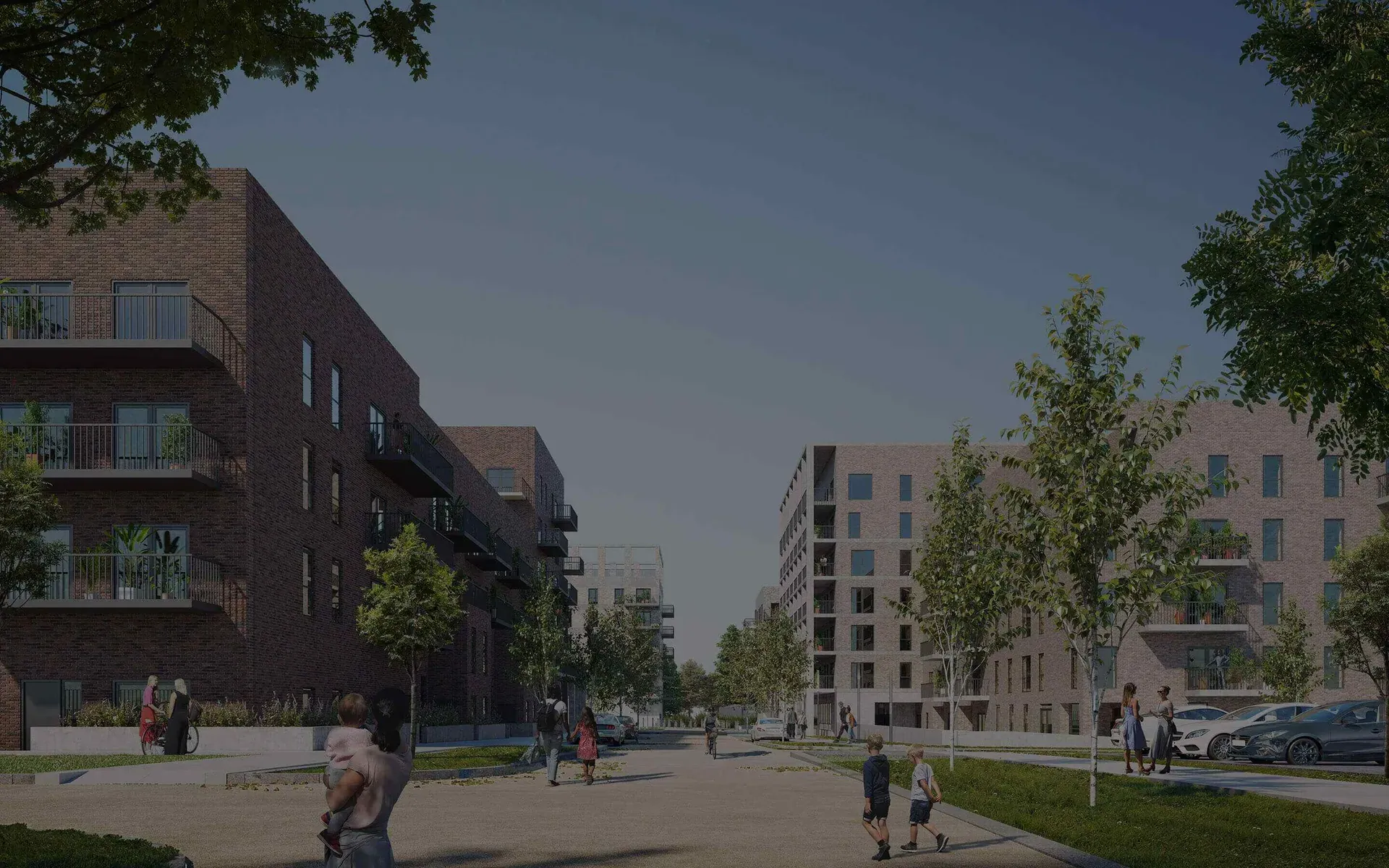
Everything, compounded by thousands. Dense housing typologies, terraces, duplexes and apartment blocks, are intrinsically compact, which is a large part of why Passivhaus at scale works economically. At Seven Mills in Dublin, the 5,500-home new town Mosart is certifying with Cairn Homes, the typologies themselves do a share of the thermal work before any insulation is specified: every party wall in a terrace and every shared floor in an apartment stack is envelope the scheme never has to build. The same logic runs through Shanganagh Castle, where 550 plus Passivhaus social homes sit in compact blocks rather than scattered units.
At that scale the form factor decision is repeated thousands of times, so a small geometric efficiency multiplies into a serious capital saving, and the inverse multiplies too. This is the quiet reason masterplanning and Passivhaus at scale belong in the same conversation: the masterplan fixes the typology mix, the typology mix fixes the form factors, and the form factors set the cost of every fabric decision that follows on a scheme like Seven Mills.
Where Mosart fits
Mosart sits at both ends of this decision: as architects shaping massing at feasibility, and as certifiers watching the consequences land in PHPP. Test your own geometry in the fabric heat loss tool, or bring a scheme to our architecture team while the shape is still free to change.