Damp and mould monitoring for Awaab’s Law
The law sets deadlines in working days. Pulse keeps a dated record of the conditions and of what was done.
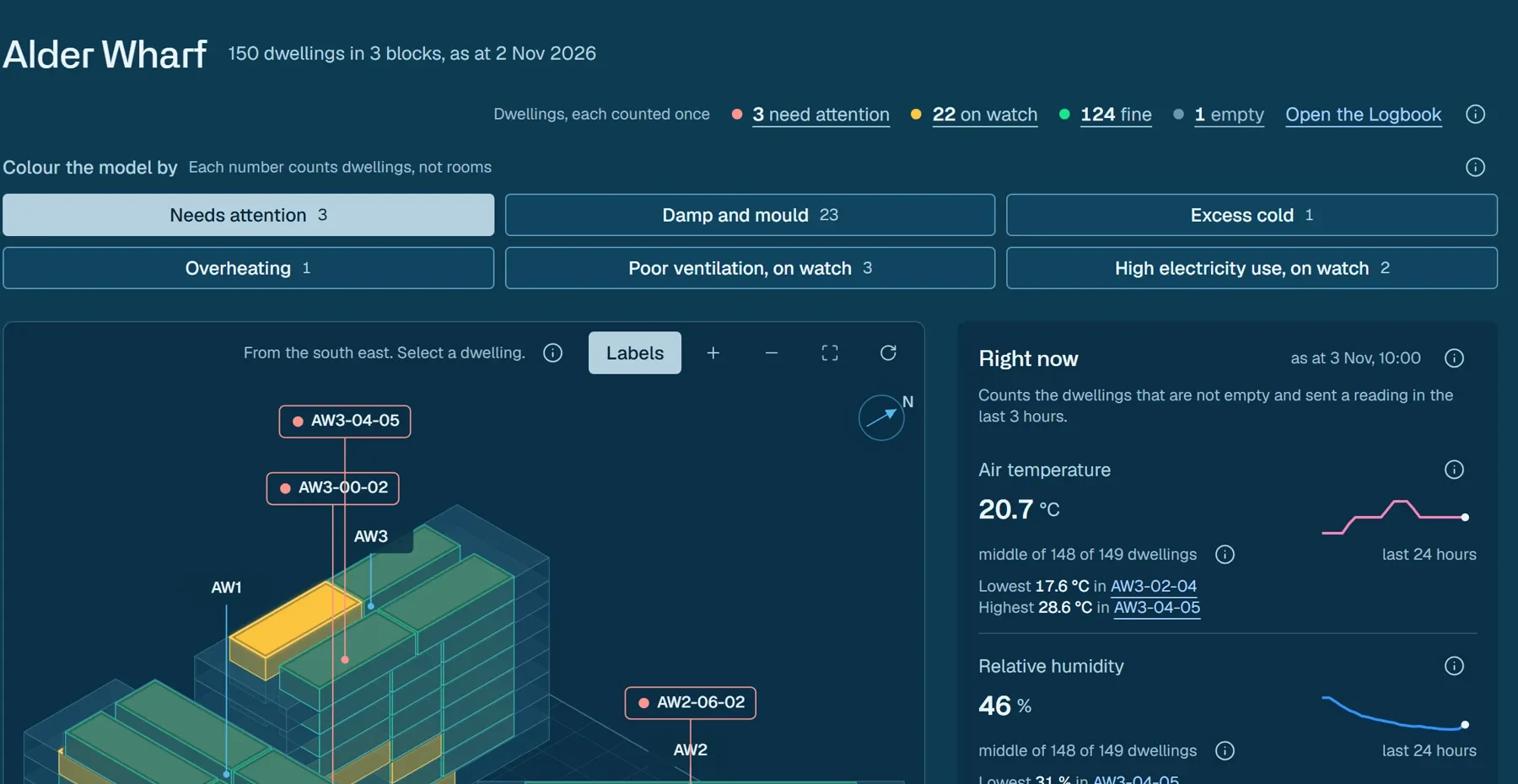
Awaab’s Law is the duty on social landlords in England to investigate and make safe damp and mould hazards within fixed timescales. Pulse monitors temperature and humidity in each home, flags the conditions mould needs, and keeps a dated record of what was seen and done.
- In force in England for social landlords since 27 October 2025
- Emergency hazards: investigate and make safe within 24 hours
- Significant damp and mould: investigate within 10 working days, start safety work within 5 more
- Excess cold and excess heat follow in 2026, other hazards in 2027
- Scotland: damp and mould regulations in force from 6 October 2026, social and private landlords
Damp and mould, on a demo scheme
A failed extract fan, found from the readings and followed to a close.
Demo scheme. The figures are illustrative, not a client result.
What the law asks of you
For an emergency hazard, investigate and make safe within 24 hours. For damp and mould that poses a significant risk of harm, investigate within 10 working days, send the tenant a written summary within 3 working days of finishing, and start safety work within 5 working days of the investigation concluding. If a home cannot be made safe in time, the landlord must provide suitable alternative accommodation at its own expense.
It covers almost all social housing let under a tenancy by a registered provider. The guidance does not mention sensors or say that monitoring data will be accepted as evidence. The clock starts when you become aware, so a dated reading shows when conditions began and a dated entry shows what was done. The duty stays with the landlord.
In Scotland, the Investigation and Commencement of Repair (Scotland) Regulations 2026 came into force on 6 October 2026. They apply to social and private landlords and at first cover damp and mould only. Landlords elsewhere should check the rules that apply to them.
What Pulse records for each home
Pulse flags a home when relative humidity stays over 70 % with air under 18 °C, or a surface is within 3 K of the dew point, for 48 hours.
Risk register
Every home with the damp and mould condition, worst first, with how long it has run.
Readings by room
Temperature and humidity room by room, against the published lines.
Logbook and time left
A line for every home, day by day. When a case opens, Pulse shows the time left for 24 hours, 10 working days or 5 working days.
A dated record for each home
The flag, the readings, the entries, the actions and the closing readings, for a tenant, an ombudsman or a regulator.
Related: post occupancy evaluation, energy and ESG reporting.
Who is behind Pulse
Mosart has worked on building performance since 1993 and has been the Passivhaus designer or certifier on around 10,000 homes and 7,500 student bed spaces. We are an RIAI registered practice with seven Passivhaus certifiers accredited by the Passive House Institute. The people who set up Pulse are the people who certify the buildings it watches.

Questions landlords ask
- What does Awaab’s Law require of a landlord?
- Since 27 October 2025, social landlords in England must investigate damp and mould that poses a significant risk of harm within 10 working days of becoming aware of it, tell the tenant in writing within 3 working days of finishing, and start safety work within 5 working days of the investigation concluding. Emergency hazards must be investigated and made safe within 24 hours.
- Does Awaab’s Law apply to private landlords?
- In England it applies to social housing let by registered providers, including councils and housing associations. The government has said it will be extended to the private rented sector, with no date confirmed at the time of writing. In Scotland the 2026 regulations cover both social and private landlords.
- When do excess cold and overheating come in?
- The government guidance says the second phase, which includes excess cold and excess heat, follows in 2026, and the remaining housing health and safety hazards except overcrowding follow in 2027. The guidance gives the year, not a day. Pulse already watches cold and heat in every home, so the record builds before the date.
- Do sensors prove a landlord has complied with Awaab’s Law?
- No. A sensor cannot prove compliance on its own, and the guidance does not require monitoring. A monitoring record can show when conditions that favour mould began, what you did and what the readings did next. Pulse keeps that record dated and exportable. The duty stays with the landlord.
- What conditions does Pulse flag as a mould risk?
- Pulse flags a home when relative humidity stays over 70 % with air under 18 °C, or when a surface is within 3 K of the dew point, for 48 hours. The thresholds are published with their source and apply to every home.
Get a quote
Tell us how many homes and which blocks worry you most. Mosart’s engineers will propose the sensors, set them up and show you the register on your own homes.
Or call +353 404 25777. Ask for the Pulse team.