Air quality monitoring for schools and training centres
Pulse measures CO2, temperature and humidity in each classroom and workshop and shows which rooms are short of fresh air.
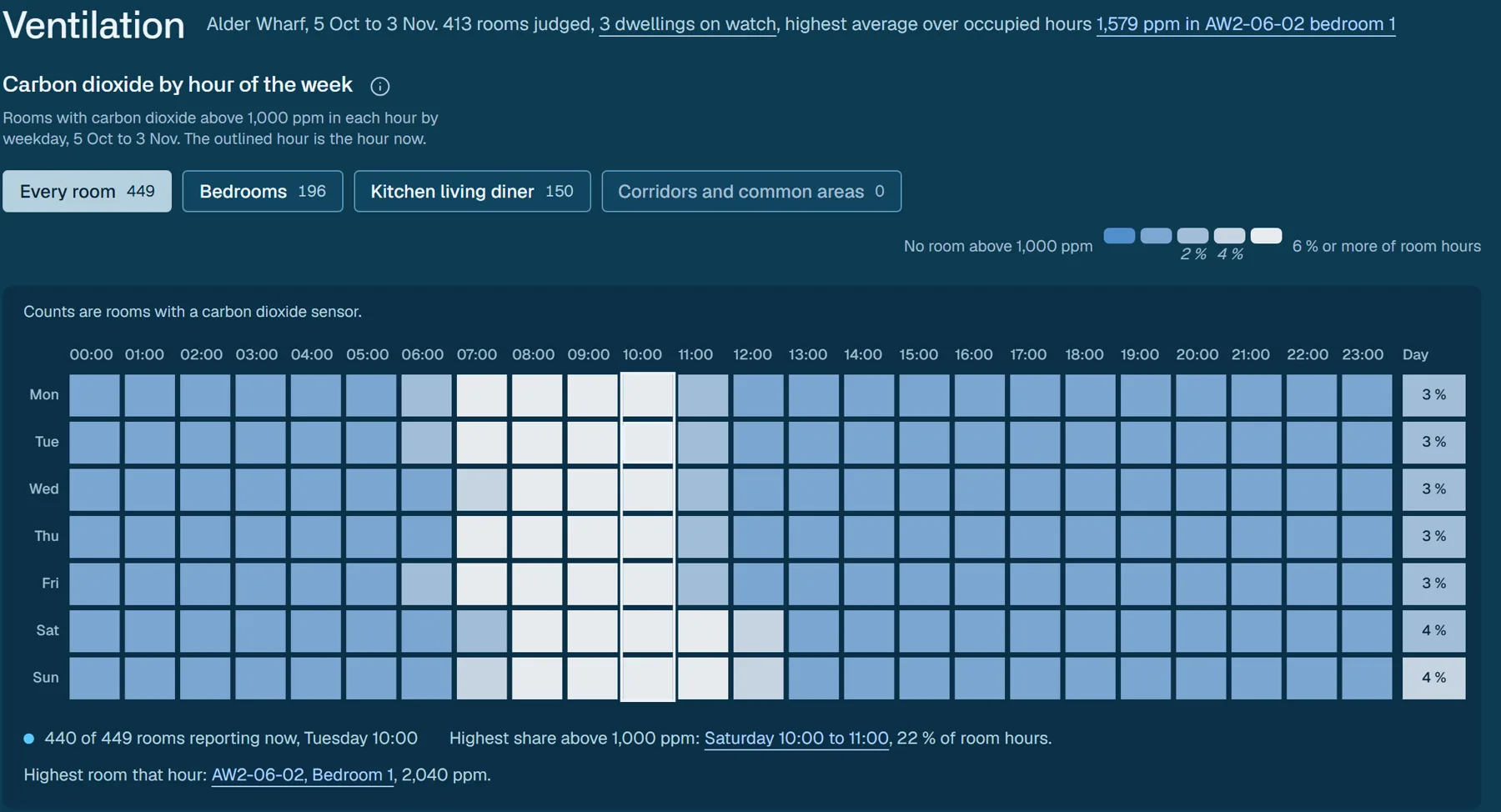
Air quality monitoring for schools and training centres means measuring CO2, temperature and humidity in each teaching space. Pulse uses wireless sensors, shows which rooms are short of fresh air or too warm, and tracks them against published lines such as BB101 for schools in England.
- CO2 over 1,000 ppm for more than 30 % of occupied hours flags a room for poor ventilation
- Building Bulletin 101 (2018) sets CO2 targets by ventilation type for English schools
- Irish schools were supplied CO2 monitors in 2021 under Department of Education guidance
- US: ASHRAE 62.1 and EPA IAQ Tools for Schools are the reference frameworks
What the guidance asks
In England, Building Bulletin 101 from the Department for Education (2018 edition) is the design guide for ventilation, thermal comfort and indoor air quality in schools. It sets CO2 targets by how a room is ventilated, lower for mechanical ventilation and higher for natural, and points to CIBSE TM52 for overheating. The document is the authority on the figures.
In Ireland, the Department of Education issued Practical Steps for the Deployment of Good Ventilation Practices in Schools. About 35,000 CO2 monitors were supplied to schools in 2021, and the guidance tells schools to increase ventilation when readings climb. New school buildings have included monitors under the technical guidance since 2019.
In the United States, ASHRAE Standard 62.1 and the EPA’s Indoor Air Quality Tools for Schools are the usual references. Oregon and California have laws about CO2 monitors in schools. Check your own state.
What a hand held monitor does not show
A hand held monitor tells a teacher what the air is like now. It does not show which rooms run short of fresh air every Tuesday, or whether new ventilation changed anything.
Pulse keeps the readings by hour of the week. A room that fills up in period three every day shows up as a pattern an estates manager can act on.
A ventilation fault, on a demo scheme
Found from the readings before anyone drove out. Classrooms are read on the same screens, against the same 1,000 ppm line.
Demo scheme. The figures are illustrative, not a client result.
What Pulse checks in a school
Poor ventilation
CO2 over 1,000 ppm for more than 30 % of occupied hours flags a room. Occupied hours follow the school day, so nights and holidays do not dilute the figure.
Overheating
Each room read on its own over the summer term, so a top floor south room is not averaged with a cool ground floor room.
Excess cold
Rooms under 18 °C are on watch and rooms under 16 °C need action, for a Monday when the heating did not come on.
Schools mode
Rooms grouped by type, the BB101 CO2 and overheating set across the school on request, a term by term comparison and a report for governors or the trust.
Who is behind Pulse
Mosart has worked on building performance since 1993 and has been the Passivhaus designer or certifier on around 10,000 homes and 7,500 student bed spaces. We are an RIAI registered practice with seven Passivhaus certifiers accredited by the Passive House Institute. The people who set up Pulse are the people who certify the buildings it watches.
Questions schools and colleges ask
- What CO2 level is acceptable in a classroom?
- Building Bulletin 101 (2018) for England sets targets by ventilation type. For mechanically ventilated rooms the daily average should stay under 1,000 ppm. For naturally ventilated rooms the target is higher, at 1,500 ppm. Pulse flags a room when CO2 is over 1,000 ppm for more than 30 % of occupied hours, and the line can be edited per site.
- Do Irish schools need CO2 monitors?
- The Department of Education supplied CO2 monitors to schools during 2021 and issued guidance on ventilation, and new school builds include monitors under the technical guidance. Check the department’s current guidance for what applies to your school.
- Can it track overheating in classrooms and workshops?
- Yes. Temperature is measured in each room, and every room is read against the same published overheating line, 25 °C for Passivhaus buildings. A school can adopt the criteria BB101 points to in England on request.
- What about workshops, labs and kitchens?
- CO2 and temperature are still the base measures, read against the same published thresholds as every other room. For a specific hazard such as welding fume, a specialist measurement is needed beyond Pulse.
Get a quote
Tell us the site, the number of teaching rooms and the ventilation type. Mosart’s engineers will propose the sensors, set them up and read the first term with your estates team.
Or call +353 404 25777. Ask for the Pulse team.